
By Johan Van Overtveldt & Dieter Van Esbroeck
The intensity of tornadoes is expressed on the Fujita scale and the Enhanced Fujita (EF) scale. The most destructive tornadoes to hit Earth so far registered as EF5, characterized by wind speeds exceeding 200 miles (or 320 kilometers) per hour. While EF6 tornadoes have not yet been registered, it could be argued that the corporate and entrepreneurial world within the European Union is currently being hit by something akin to an EF6 tornado—a merciless storm fueled by five powerful engines.
In the second quarter of 2026, business registrations in the European Union decreased by 0.5%, with the industrial sector being hardest hit, while bankruptcies of existing companies rose by 5.7% compared to the previous quarter. These data, released by the European Commission, confirmed the trend of deep malaise already visible for some time in Europe’s corporate and entrepreneurial world. Since 2022, corporate bankruptcies have continuously risen in Europe. Delayed payments, a clear sign of mounting stress, have also been constantly on the rise. In 2026, 1.3 million jobs are threatened by corporate insolvencies out of 2.2 million endangered jobs worldwide. Companies across the EU are shedding jobs, and announcements of operating losses are daily news (a 5.9 billion euro loss at Volkswagen in only the third
quarter of this year!).
“In 2026, 1.3 million jobs are threatened by corporate insolvencies out of 2.2 million endangered jobs worldwide.”
In more leftist political circles and among labor unions, one often hears these days that European business leaders should be more humble and engage in self-reflection instead of complaining and lamenting. These corporate “moaners,” so the critique goes, were asleep at the wheel and reacted much too slowly and timidly to the challenges posed by new technologies and forceful competition, especially that emanating from China. Corporate EU has nothing but itself to blame.
This criticism is largely misplaced because, in order to function and operate efficiently and competitively, the corporate and entrepreneurial sector needs, so to speak, “room to move.” The regulatory, administrative, financial, and cultural environments must be such that the natural instincts of entrepreneurs—what John Maynard Keynes described as the “animal spirits“—can develop and flourish, of course within the context of existing laws. If and when incentives turn into disincentives, corporate and entrepreneurial activity will suffer structurally, with fatal consequences for economic growth, the future of the welfare state, and societal peace and calm in general. In Europe, the disincentives for business and entrepreneurial activity have turned into an EF6 tornado powered by five massive engines.
Two Traditional Factors
Two of the five disincentives have been in place for a longer time. The first is the overall tax burden. Total tax revenues in 2024 amounted to 39.4% of GDP in the EU, compared to 25.6% in the US. The tax burden on work, in particular, is heavy. The average tax wedge (the difference between the gross wage cost to the employer and the net wage earned by the employee) stands at 41.7% for the 22 EU countries covered by OECD data, and at 30% in the US. Countries leading in the tax wedge are Belgium (52%), Germany (49%), and France (47%). Capital taxation is also heavier in Europe than in the US. According to OECD statistics, capital-related taxes stand at 8.5% of GDP in Europe and at 5.6% in the US, though a caveat regarding the comparability of capital tax data is certainly in order here. Higher capital taxes, among other things, curb the inclination to invest and innovate.
A large tax wedge for labor income makes it harder for companies to implement promotional and motivational policies for their workforce, a factor negatively impacting personnel involvement and productivity. Closely linked to the tax wedge issue is the heavy labor cost European companies have to bear. Of course, productivity must be taken into account to achieve a meaningful comparison of the real labor cost burden. Unit labor costs are the most commonly used parameter for measuring real wage cost differentials. The German research institute iW (Institut der Deutschen Wirtschaft) has computed these unit labor costs and concludes that European companies are at a huge disadvantage compared to their American competitors.
Unit labor costs, taking into account the impact of exchange rates, were 28% higher in the euro area than in the US for the year 2024. Germany (+47%), Austria (+43%), France (+41%), Belgium (+37%), Italy (+34%), and Spain (+24%) are in the top league. The Netherlands perform comparatively well at (only) +10%, slightly better than Japan (+12%). Countries outperforming the US on labor unit cost are Sweden (-10%) and Denmark (-16%). Although the differences in unit labor cost are significant and structural, a caveat regarding the data is also in order here. For example, these data only very incompletely capture differences in product quality. However, the overall picture is unequivocal: labor costs weigh more heavily on companies’ P&L accounts in Europe than in the US.
“Unit labor costs, taking into account the impact of exchange rates, were 28% higher in the euro area than in the US for the year 2024.”
The second disincentive of old relates to the notion of “creative destruction,” first explicitly introduced by the legendary economist Joseph Schumpeter in his 1942 magnum opus, Capitalism, Socialism and Democracy. According to Schumpeter, “the process of Creative Destruction is the essential fact about capitalism… (it is) …the process of industrial mutation that incessantly revolutionizes the economic structure from within, incessantly destroying the old one, incessantly creating a new one.” Creative destruction fundamentally involves the replacement of less productive existing companies by innovative new challengers. The readiness to embrace creative destruction and corporate renewal, and even the enthusiasm with which they are generally received, is much more pronounced in the US than in Europe. Creative destruction is a primary driver of productivity advancement and, consequently, a powerful driver of economic growth.
“The readiness to embrace creative destruction and corporate renewal, and even the enthusiasm with which they are generally received, is much more pronounced in the US than in Europe.”
As Pierre Wunsch and Geert Langenus argue in their seminal paper on Eurosclerosis 2.0, “deep-seated social preferences” or cultural characteristics cause Europe to lag in technological innovation and in its acceptance of the merits of creative destruction: “Europeans are less comfortable with disruption, favor greater redistribution, and are more risk-averse.” Moreover, more Europeans than Americans tend to view the economic system as inherently unfair. These general sentiments are also largely responsible for significant institutional differences between Europe and the US, with more rigid labor market organization and more complicated bankruptcy procedures being prime examples. Both of these characteristics contribute substantially, as research shows, to corporate Europe’s difficulties in timely and adequately restructuring and quickly adapting to changed circumstances.
Europe’s present-day social and cultural preferences, and the linked institutional characteristics, limit the extent to which creative destruction can occur, thereby also limiting companies’ and entrepreneurs’ ability to adjust and transform innovative potential into concrete business operations. Creative destruction requires the fluid reallocation of capital and labor. Europeans tend to focus on the shorter-term social consequences of such reallocations, whereas in the US, the longer-term benefits associated with the smooth functioning of creative destruction are more appreciated. “Deep-seated social preferences” cannot, of course, be changed overnight, but meaningful policy adjustments, especially in labor and tax laws, could certainly initiate a much-needed shift in social preferences.
Regulatory Derailment
Most EU member states clearly exhibit a “dynamic deficit” when compared to the US (and also most of Asia). This deficit is not so much due to a sudden lethargy or laziness taking hold of corporate and entrepreneurial Europe as it is due to an environment that heavily weighs on initiative, hard work, innovation, and investment. In addition to the two more traditional elements behind this deficit discussed above, there are three relatively new dynamism-hindering, competitiveness-eroding, and activity-discouraging developments that are starting to cost dearly in terms of corporate dynamism and economic growth.
The first of this trio is Europe’s overzealousness with respect to regulation and reporting obligations. We’ve lived through an era where, for a majority of political groups, “more Europe” was supposed to be the answer to most of the problems that befell the continent. Driven by a well-understood awareness of the need to emphasize and reinforce their own raison d’être, a growing army of European bureaucrats constantly fueled this “more Europe” engine. As Luis Garicano, Bengt Holmström, and Nicolas Petit argue in their Constitution of Innovation: “EU institutions have embraced a defensive, regulation-first approach, believing that rulemaking is Europe’s “superpower” and that the “Brussels Effect” will set global rules. This theory is failing in practice.” Failing it is, big time.
Especially over the last decade, a tsunami of European regulatory initiatives has overwhelmed the continent. Overregulation or misguided regulation has caused us to largely miss the boat on the digital economy, and we are fully engaged in repeating the same mistake concerning AI (artificial intelligence). Whereas between 2019 and 2024, more than 13,000 laws and regulations saw the light of day in the EU, in the US, this number was limited to 3,500. The Draghi report on EU competitiveness estimates the annual cost of complex procedures, excessive national requirements on top of basic EU regulation, and unharmonized labeling standards at no less than 200 billion euros.
“Overregulation or misguided regulation has caused us to largely miss the boat on the digital economy, and we are fully engaged in repeating the same mistake concerning AI.”
The alphabet soup of EU-induced regulations is long: Corporate Sustainability Reporting Directive (CSRD), Corporate Sustainability Due Diligence Directive (CSDDD), General Data Protection Regulation (GDPR), EU AI Act, Digital Markets Act (DMA) & Digital Services Act (DSA), Extended Producer Responsibility (EPR), and much more, not to mention, of course, the massive Green Deal. Let us be unequivocal: substantial parts of all these regulatory initiatives were needed, but in too many cases, exaggeration, inefficiencies, and complexities (if not outright internal contradictions) gained the upper hand, not least because of the overly complicated way in which European decision-making is organized. The problems created by misguided regulation are particularly serious for smaller businesses.
A factor further enhancing the damage done by harmful regulation is what Luis Garicano has defined as The Compliance Doom Loop: “Europe is creating a new ruling class – but they don’t make laws or deliver services. Instead, they check boxes and issue stamps of approval. These are the compliance officers who ensure other people follow rules. From ESG reporting to sustainability audits, from data protection to supply chain verification, checkers and verifiers have become a fast-growing segment of the economy. European business is increasingly governed by a group of rule-enforcers that, rather than create economic activity, shrink it.“
Last but not least, there is the redirecting of entrepreneurial activity due to an overload of complex and obscure regulation. Entrepreneurs increasingly spend time and energy trying to take advantage of that complexity and obscurity. “Regulatory arbitrage” is consistently present in financial markets but is increasingly taking hold in other sectors of the economy as well. As William Baumol warned in 1991, entrepreneurship in such circumstances tends to become “unproductive and even destructive.” This kind of rent-seeking, where individuals and companies try to increase their wealth without creating any new wealth, goods, or services, is a substantial drag on economic growth, as was convincingly shown more than three decades ago by Kevin Murphy, Andrei Shleifer, and Robert Vishny.
Gasification
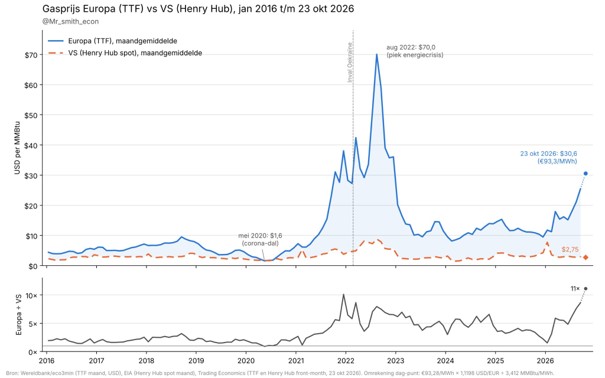
A second relatively new hindrance for entrepreneurial initiative and economic activity in the EU has to do with the price of energy. Especially since the start of Vladimir Putin’s war against Ukraine, the gas price has escalated drastically (see graph). Up until 2021, the European gas price was on average two times the price in the US, or even less. During the second part of 2022, the difference rose steeply to ten times the American price. As of 2023, the difference oscillated around five times, only to escalate again to around ten times, recently even up to twelve times. It is, of course, shale gas production in the US that makes all the difference (contrast this with the outright European stupidity of filling gas production units with concrete; see our blog The Groningen Madness of October 1, 2026.
Gas is not only an important commodity in the energy supply chain but also a raw material for industries, most of all the chemical sector. As the gas price in the EU is now again around twelve times higher than in the US (graph below), it is simply impossible for European manufacturers to compete with American producers. The evolution of electricity prices reinforces this competitiveness-strangling effect of sky-high gas prices. According to the International Energy Agency, EU electricity prices for energy-intensive industries were in 2025 on average more than twice US levels and more than 50% higher than in China and India.
“As the gas price in the EU is now again around twelve times higher than in the US, it is simply impossible for European manufacturers to compete with American producers.”
This huge energy price handicap for European companies stems to a large extent from the successive faulty decisions made by European authorities, culminating in the Green Deal. Not only was further investment in fossil fuel development made largely impossible, but nuclear energy was also banned from the available options (an error that recently started to get corrected). All bets were placed on the development of sustainable energy sources like wind and solar. The prospects of this development were overestimated, and especially the transition period needed to go from where we are today to a world fully based on sustainable energy sources was manifestly ignored.
China Shock
The third relatively new shock corporate and entrepreneurial Europe has to undergo emanates from China. We can be brief here, as we elaborated on this shock extensively in our blog, “To Stop the Chinese Tsunami,” on October 7, 2026. To summarize briefly, the massive increase in Chinese imports into the EU (600 billion euros this year) is based on fundamentally dishonest competition. The Chinese economic model exhibits four characteristics that completely disrespect the rules of fair free trade: massive subsidization, substantial undervaluation of its currency, strict protectionism for its own market, and continuous theft of Western intellectual property.
“To summarize briefly, the massive increase in Chinese imports into the EU is based on fundamentally dishonest competition.”
So, all in all, five factors are having the effect of an EF6 tornado on the abilities of corporate and entrepreneurial Europe to compete, innovate, and invest: high tax burdens and labor costs, cultural disinclination towards creative destruction, misguided and overly complex regulation, exorbitant energy prices, and mala fide competition from China. Dealing with one, two, or even three such headwinds would be more or less doable for most corporate and entrepreneurial entities, but five headwinds are definitely too much, as recent reports about economic activity in the private sector increasingly underline. In order to deal with the many challenges the EU and its member states have to face, urgent action is needed to weaken the present tornado’s destructive power. The European Commission should take the lead in all this, but unfortunately, we have recently heard more grandiose promises than we’ve seen concrete action.

