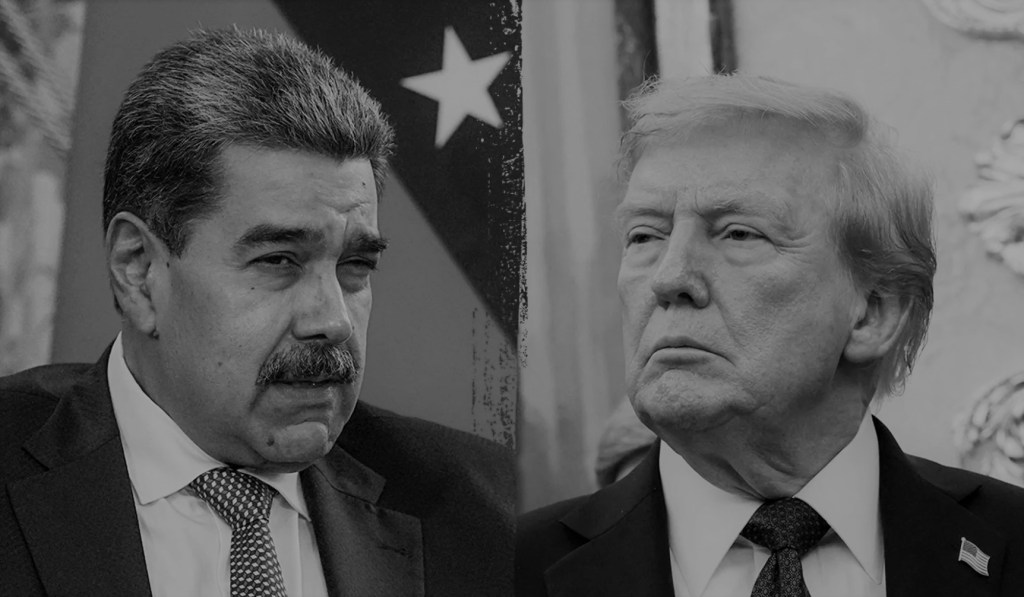
In a world already suffering from increasing uncertainty and chaos, American actions against Venezuelan President Maduro are the latest additions to the turmoil. The likelihood that the real reasons behind this shocking intervention are substantially different from those formulated in the New York court, where Maduro and his wife were charged with drug trafficking (“narco-terrorism”) and various weapons offenses, is high.
The timeline is there for everyone to observe. On December 29 of last year, Israeli Prime Minister Benjamin Netanyahu visited American President Donald Trump at the latter’s Mar-a-Lago resort in Florida. Several sources confirmed that during that meeting, Netanyahu presented Trump with new and alarming evidence of Iran’s attempts to upgrade its ballistic missile capabilities and the renewed rebuilding of damaged nuclear facilities by the theocratic regime in Tehran. During the press conference following the tête-à-tête between the two heads of state, Donald Trump enthusiastically claimed that he would “immediately” back Netanyahu if the latter asked for a new bombing of Iranian nuclear facilities.
From Iran to Caracas
Less than a week after Netanyahu’s visit, Donald Trump ordered American security and military forces to enter Venezuela, apprehend President Maduro and his wife, and bring them to the United States to stand trial in New York. This operation against Madero was already in preparation for some time as illustrated by the revelation of the deal between Trump administration officials and Venezuelan vice-president Delcy Rodriguez by Bloomberg. Netanyahu’s messages accelerated the move.
The military operation into Caracas was apparently executed rather flawlessly – without any resistance at all from the Venezuelan army leading to the suspicion that at least part of that army was informed of the American infiltration – and so Maduro is no longer at the helm in Venezuela. Trump now considers the country that possesses the world’s largest oil reserves – 303 billion barrels of proven oil reserves or something like 17% of the global world oil reserves – more or less as the 51st state of the United States. It remains to be seen how this “annexation” will work out over time but the fact of the matter is that for the moment the American coup has changed the oil business outlook and everything related to it in a substantial way.
“Trump now considers the country that possesses the world’s largest oil reserves more or less as the 51st state of the United States”
Oil as Strategic Insurance
Now let’s connect Netanyahu’s visit with Maduro’s ousting. If you take seriously the Israeli and American categorical refusal to allow Iran to acquire a nuclear bomb and the means to deliver such a bomb, then the message brought by Netanyahu at Mar-a-Lago makes an intense future conflict with the theocratic regime in Tehran unavoidable. Such a conflict will almost certainly disrupt oil flows out of the Middle East, particularly because the current Iranian leadership will undoubtedly attempt to target Saudi Arabian oil export facilities if a region-wide conflict ensues.
Viewed in this context, Maduro’s ousting makes sense as a means of securing control over Venezuelan oil production and reserves, serving as an insurance policy for the United States against Middle Eastern oil supply disruptions. This new situation in the oil market increases the pressure that the U.S. and Israel can exert on the regime in Tehran, which is already suffering at the moment from high inflation, economic contraction and major internal protests and upheaval, and makes any eventual military conflict more manageable from a political and economic standpoint. Moreover, a stronger grip by the U.S. on the international oil business also allows Washington to reinforce the role of the dollar in the international financial system.
Also part of Iranian equation for Washington is the fact that Iran has been building up extensive drone facilities in Venezuela with Iranian specialists and advisors present on the ground in the South American country. Given the relative proximity of Venezuela to the US, these facilities are considered to be a significant threat by the US army top. Right before the American raid on Maduro the US Treasury department issued a statement in which it said to hold “Iran and Venezuela accountable for their aggressive and reckless proliferation of deadly weapons around the world”.
If the Iranian issue is as important as implied above—and this scenario remains a hypothesis supported by circumstantial evidence but lacking ironclad proof—it is clear that there are several loopholes and major uncertainties related to this strategy. The first relates to the currently very volatile situation inside Venezuela, which could result in total chaos and uncertainty. It increasingly looks like the army and security forces taking control of the streets. The second issue arises from the dire state of the Venezuelan oil industry. During the 1970s, Venezuela produced 3.5 million barrels of oil per day; in recent times, it has barely managed 1 million. Decades of mismanagement, lack of investment, and rampant corruption under socialist dictators Hugo Chavez and Nicolas Maduro have reduced the potential oil giant Venezuela to an oil dwarf (with huge reserves!).
Increasing Venezuelan oil production in response to, for example, disruptions in oil exports from the Middle East is currently hardly feasible. According to oil analysts at JP Morgan, it will take two years to increase daily output to 1.4 million barrels and almost a decade to reach 2.5 million barrels. If the massive investments in the Venezuelan oil facilities that Donald Trump has called for were realized relatively quickly, then progress could occur faster in the Venezuelan oil industry. However, the initial reactions from oil industry leaders in the U.S. and elsewhere do not reflect overwhelming enthusiasm for following up on Trump’s call for massive investment.
Strategic Overreach?
The Trump administration has not excelled in its first year in office with well-thought-out strategic actions and maneuvering. It is entirely possible that the Iranian issue has indeed entered into the decision-making regarding Venezuela, but that the consequences and the factual reality on the ground have been substantially misjudged. Hence, there is a real possibility that the Trump administration has created a situation that might develop in ways and directions substantially different from what was envisioned at the start.
Not only Iran
Let us also not forget in this context that, in addition to the Iranian issue, there are three further elements that go beyond the accusations formulated in the New York court and that also played a more or less important role in the American decision to “go for it” in Venezuela.
First and foremost there is the grander scheme of Venezuela’s vast natural resources. As already indicated the country has the largest proven oil reserves and ranks worldwide 6th place for gas reserves. Venezuela also has vast reserves of gold and diamonds and metals like iron ore, nickel, copper and bauxite. Even more importantly, Venezuela disposes of extensive rare earth elements such as coltan, rhodium and thorium which are vital inputs into mobile phones, electric vehicles and military applications. As is well known, China has not hesitated to use its quasi-monopolistic position in rare earths mercilessly in trade negotiations with the US and the EU. Beijing has been trying to get control of Venezuelan resources in order to protect its present quasi-monopoly of those rare earths. The American intervention in Venezuela has certainly complicated China’s strategy to dominate vital supply chains.
A second issue is Venezuela’s position in the cryptocurrency world. The regime in Caracas has apparently accumulated an impressive reserve of the two major cryptocurrencies, Bitcoin and Tether, over the past decade. According to intelligence reports, this shadow reserve is estimated to be no less than $60 billion and was built up through gold swaps and settlements of oil exports conducted in cryptocurrencies to avoid sanctions. Caracas ranks among the top five Bitcoin holders in the world. As is well known, the Trump administration is very interested in cryptocurrencies and their potential impact on the international role of the dollar.
A third element that almost certainly entered into the White House decision making regarding the action in Venezuela is the relationship between the Maduro regime and the communist regime in Cuba. Venezuela became the principal ally of the ailing Havana regime, providing the latter with oil and financing in exchange for Cuban doctors, teachers, and security personnel. Without Venezuelan aid, the Cuban economy would be in an even greater disaster than it is today, with shortages of almost everything the population needs. The Cuban population has declined by 15% over the past decade. The often-praised Cuban health sector is completely collapsing.
“Without Venezuelan oil, the Cuban regime risks losing its last economic lifeline”
It seems that the ousting of Maduro will leave the Cuban regime without any major external benefactor, significantly increasing the chances of an implosion of the communist regime in Cuba. Such an evolution in Havana has long been a major objective of American policy. However, much uncertainty remains regarding how that will all work out in the end and what path a new leadership in Cuba will take. Add Cuba to the list of uncertainties fueling the chaotic turmoil in our world.

