
Under President Trump, the pressure on the American central bank, the Fed, to follow orders from the White House has increased tremendously. For American inflation and worldwide financial stability it is of crucial importance that the next Fed chairman, to be appointed by May 2026, stands firm on the institution’s independence.
American President Donald Trump is discovering, much to his displeasure, one of the oldest laws of the electoral ebb and flow, namely that cost-of-living increases tend to be very punishing for those in power. His approval ratings are steadily going down and the Democrats succeeded in winning the most recent elections, even the race for Miami’s mayorship which for 30 years was safely in Republican hands. It is quite evident that this downward tendency for Trump & Co. is linked to the steady increase in the United States in the prices of basic necessities such as groceries and rent. The President’s virulent outcries that the “affordability” discourse constantly aired by the Democratic opposition is “a hoax”, have lost all credibility.
The phantom tale
Due to the government shutdown in the United States that lasted 43 days and ended mid-November there are significant delays in the release of economic data. As far as inflation is concerned, the most recent data relate to September. Annualized inflation, as measured by the consumer price index, stood at 3% at the end of September. Core inflation, being the overall inflation rate with the volatile components food and energy taken out, also came in at 3%. The 3% inflation trend is broad-based: energy inflation ran end September at 2.8%, food inflation at 3.1%, rent inflation at 3.60% and services inflation at 3.60%.
The 3% inflation increase in September is the highest increase since January of this year, the moment of Donald Trump’s inauguration. It would hence be quite surprising to have American citizens not blaming President Trump for the increases in their cost of living. The President and his entourage try every trick in the book to keep this “guilty verdict” away. This leads to sometimes quite bizarre arguments as the ones recently developed by Stephen Miran who in September was appointed by President Trump as member of the Federal Reserve Board of Governors.
“ The 3% inflation increase in September is the highest increase since January of this year, the moment of Donald Trump’s inauguration”
During a speech at Columbia University’s School of International and Public Affairs governor Miran launched the concept of “phantom inflation”. If all the “noise” is taken out of the published inflation data, so Miran argued, annualized inflation is running very close to the Fed’s 2% inflation target. Miran explained that “excess measured inflation is unreflective of current supply-demand dynamics … If we further remove housing and look at market-based core excluding shelter, underlying inflation is running below 2.3%, within noise of our target”. This line of argument does not hold up to close scrutiny. Of course, the cost of housing and rent is a very important part of what people experience as their cost of living. And “unreflective of current supply-demand dynamics” sounds a lot like some sort of voodoo economics.
Powell Crucifixion
Given the news from the inflation front, the present stance of monetary policy in the US seems quite all right. The federal funds rate, the most significant Fed policy rate since it is this rate that the Fed charges for short-term loans, stands at 3.50-3.75% which means that in real terms (i.e. adjusted for inflation) the federal funds rate is slightly positive. In its last three meetings the Federal Open Market Committee (FOMC) each time brought down this policy rate by 25 basis points. On December 10 the FOMC was deeply divided on the third consecutive cut. Three of its twelve members wanted a 50 bp cut, among whom Stephen Miran, while several FOMC members were very hesitant regarding the third 25bp cut in a row.
The December vote on interest rate policy fully reflects the difficult situation in which the Fed’s main policy body has arrived. While the Federal Reserve Act of 1913, amended several times as in 1977, guarantees that the Fed can set interest rates without interference from Congress or the President, Donald Trump has shown not much respect for this independence of the American central bank. More specifically, the American President has been highly disrespectful of the Fed’s present chairman Jerome Powell. Trump argued that “I’d love to fire his ass” and declared on several occasions Powell to be “mentally problematic” and “incompetent”. Powell does not seem to be really impressed, to the point that he recently even declared that “it’s really tariffs that are causing the most of the inflation overshoot”. This was not only a very courageous thing to say in Trump’s Washington, it is moreover a truthful statement.
“Donald Trump has shown not much respect for this independence of the American central bank”
It is easily forgotten in this context that it was Donald Trump who appointed during his first Presidential term Jerome Powell as chairman of the Fed in 2018. And now Trump will again have to make the choice for Powell’s succession since the present chair’s term expires in May 2026. In recent weeks Trump has put forward two names as possible new Fed chairman: Kevin Hassett, the present director of the National Economic Council and a staunch Trump disciple and Kevin Warsh, presently at work at Stanford University and already a member of the Fed Board of Governors during the period 2006-2011. Whoever of these two men is finally chosen, or an eventual third candidate still in Trump’s sleeve, all of them should take note of what happened to one of their illustrious predecessors at the Fed’s helm, Arthur Burns.
Burned
Born in the Austro-Hungarian Empire Arthur Burns (1904-1987) was a top student at Columbia University and became one of the early driving forces behind the National Bureau of Economic Research. He taught economics from 1927 until 1944 at Rutgers University where Milton Friedman was one of his star students. After the war Burns switched to policy-related jobs. He chaired President Dwight Eisenhower’s Council of Economic Advisors (1953-56) and served in the late 1960s as first Counselor to President Richard Nixon who appointed Burns as chair of the Federal Reserve Board in 1970, a position he held until 1978.
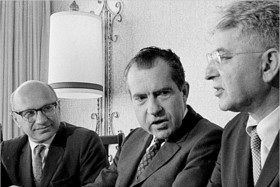
Although an economist of conservative signature with even a significant dose of monetarist blood in his veins, Burns failed abysmally as Fed chairman. Under constant pressure from the Nixon White House Burns all too often gave in and neglected to adjust monetary policy in accordance with the rising tide of inflation. Shortly after his departure from the Fed Arthur Burns delivered the Per Jacobssen Lecture at the IMF’s annual meeting of September 1979 in Belgrade. In this speech Burns showed resignation to the inflation wildfire raging through most Western countries at that moment: “It is illusory to expect central banks to put an end to the inflation that now afflicts the industrial democracies … It simply means that … (central banks’) … practical capacity for curbing inflation that is continually driven by political forces is very limited”.
Among the Belgrade public listening to Burns’ lament was Paul Volcker who at that time was a few weeks into Burns’ former job as chairman of the American central bank. Volcker later commented that he “was flabbergasted by Burns’ gloom and doom talk. He was basically saying that he had given up on fighting inflation. We had to be able to do better than that”. And Paul Volcker rose to the occasion and did better. In October 1979 he launched the Fed’s new inflation fighting approach by taking a monetarist turn and focusing on limiting the money supply. Against fierce political opposition and living through a severe recession, Volcker persevered and conquered inflation. This Volcker dividend has been a bonus on which future central bankers have been able to thrive for decades.
“ And Paul Volcker rose to the occasion and did better”
The conclusion of all this is straightforward. Price stability and financial stability in general are immensely important for the economy and for society in general. Central bankers capable of setting interest rates and monetary-policy variables in general, independent of political influences, are immensely important in order to achieve price and financial stability.
Even in Donald Trump’s United States.

