By Johan Van Overtveldt & Dieter Van Esbroeck
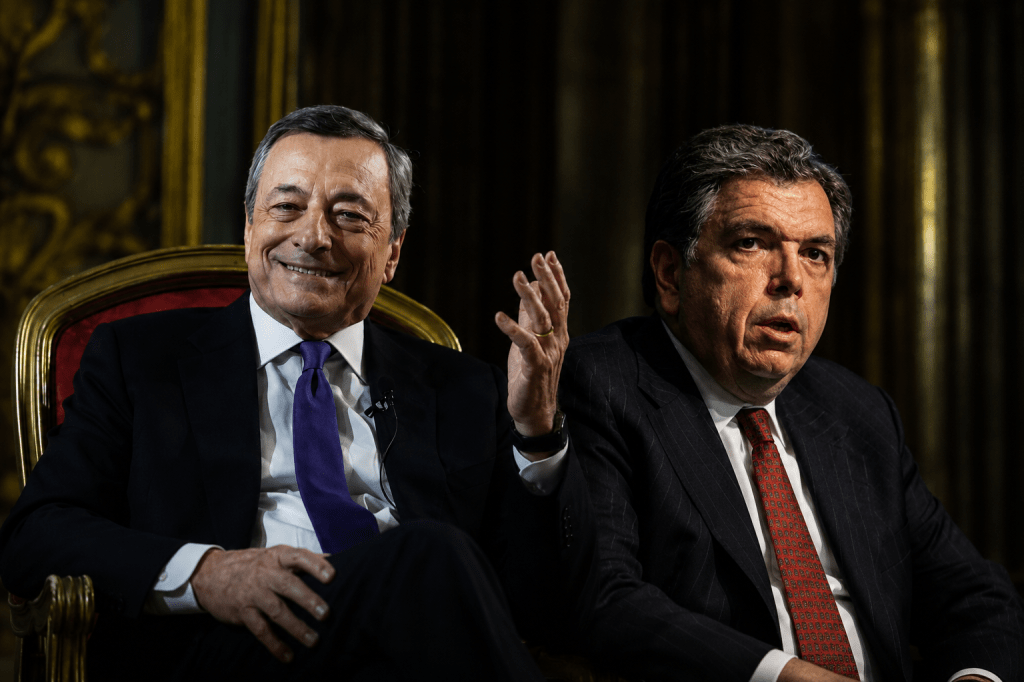
Financial markets exhibit more-than-average volatility these days, not least because of significant vulnerabilities and potential choke points lurking in the shadows. Central banks have a delicate task to fulfill, as adequate liquidity provision constantly fuels markets’ appetite for risk and debt.
Financial markets exhibit more-than-average volatility these days, not least because of significant vulnerabilities and potential choke points lurking in the shadows. Central banks have a delicate task to fulfill, as adequate liquidity provision constantly fuels markets’ appetite for risk and debt.
Some quotes stick for years, decades, even centuries. Although not especially known for their verbal virtuosity, economists have also produced some memorable quotes that have withstood the test of time. Consider one of the most famous economists ever, John Maynard Keynes. In 1923, Keynes argued that “in the long run we’re all dead.” During the 1960s, Milton Friedman popularized the slogan that “there’s no free lunch.” Herb Stein, as chairman of the US Council of Economic Advisors in the mid-1980s, declared that “if something cannot go on forever, it will stop.” These quotes still resonate and pop up regularly in speeches and commentaries.
More recently, some of the most memorable quotes in the sphere of finance and economics were produced by policymakers. In July 2007, Chuck Prince, then CEO of the huge financial concern Citigroup, declared that “when the music stops, in terms of liquidity, things will be complicated. But as long as the music is playing, you’ve got to get up and dance. We’re still dancing.” A few months later, liquidity started to dry up, and the Great Financial Crisis brought the world economy to the edge of a depression.
Almost exactly five years after Prince’s famous quote, Mario Draghi, chairman of the European Central Bank (ECB) in those days, produced his own quote for, say, eternity: “Within our mandate, the ECB is ready to do whatever it takes to preserve the euro, and believe me, it will be enough.” Draghi’s words worked like magic, almost overnight ending the turmoil that risked torpedoing Europe’s monetary union and, consequently, the euro, as a result of the Greek crisis that had already been destabilizing the entire European continent for some years. It should be noted here that Draghi’s remark was afterward most often shortened to just “the ECB will do whatever it takes.”
If only because the man will reappear in this blog later on, we include a 1990s quote from Alan Greenspan, who was chairman of the American central bank Fed from 1987 to 2006: “I know you think you understand what you thought I said, but I’m not sure you realize that what you heard is not what I meant.”
Multiple Vulnerabilities
The above quotes from Chuck Prince and Mario Draghi, even the one from Alan Greenspan, have retained much relevance with respect to what is going on in the financial and macroeconomic world of 2026—a world that is at the geopolitical level full of uncertainty, tension, and open and potential conflict areas. Such a world augments the risk that at any time one or more adverse shocks develop that produce havoc and crises in financial markets. Several serious vulnerabilities are already haunting those markets.
The massive upcoming IPOs (Initial Public Offerings) of Space X, Anthropic, and Open AI, involving hundreds of billions of dollars, are the latest addition to the list of potential sources of stress and volatility. In an earlier blog (Dancing on Volcanoes), we listed the major, already existing vulnerabilities present in financial markets: the massive debt run-up (the recent Debt Report of the OECD flags “historic highs” in borrowing: governments and corporations borrowed $27 trillion in 2025 and are expected to borrow $29 trillion this year), the rise of purely speculative cryptocurrencies and of stablecoins sorely lacking adequate supervision, escalating cyber-insecurity, the new surge in inflation and the uncertainty concerning central banks’ responses to it, and the massive expansion in the shadow banking system or the so-called NBIFs (Non-Bank Financial Institutions).
“The massive upcoming IPOs of Space X, Anthropic, and Open AI, involving hundreds of billions of dollars, are the latest addition to the list of potential sources of stress and volatility.”
In a recent report for the Group of Thirty, the NBIF issue is thoroughly mapped out by three heavyweights in the sphere of financial regulation: Agustin Carstens, former general Manager of the BIS (Bank for International Settlements) and former governor of the Banco de Mexico; Klaas Knot, former president of De Nederlandsche Bank and former chair of the Financial Stability Board; and Stijn Claessens, former deputy head of the Monetary and Economic Department of the BIS. The subtitle of their report on the NBFIs does not leave much to the imagination: “A Perfect Storm in the Making?“
The importance of the NBFIs, as the report documents, has increased substantially since the Great Financial Crisis (GFC). At that time, they represented 42% of global financial assets; by 2024, that share had risen to 51%. Given the higher capital and liquidity buffers imposed by post-GFC regulation on traditional banks, the NBFIs also substantially increased their credit provision to the rest of the economy. “Regulatory arbitrage” is the innocent-sounding term used to describe such big movements. The NBFI group includes, among others, insurance companies, pension funds, money market funds, hedge funds and other investment funds, central clearing counterparties, broker-dealers, and trust companies.
Recognizing the benefits of the enlarged role of these NBFIs, such as broadening access to finance, stronger competition, improved pricing, and better services, Carstens, Knot, and Claessens (CKC) raise substantial financial stability concerns linked to the rapid growth of the NBFIs. There is, first, the well-known mismatch between illiquid assets and runnable liabilities that in times of stress can quickly generate substantial liquidity shortfalls. Very high levels of leverage further augment the risk of chaotic unwinding of positions and the necessity of fire sales of assets. Second, the funding of the rapid expansion of NBFIs comes for a large part from the traditional banking sector, while there is also evidence of reverse movements with NBFIs providing funding to the traditional banking sector. Turmoil in the NBFI segment thus risks contaminating the traditional banking sector too. Third, there is the lack of an adequate regulatory and supervisory framework for these NBFIs in their new role.
CKC cite as recent examples of the latent stress and vulnerabilities in the NBFIs the global market turmoil of March 2020 and the stress in the UK gilt market of 2022, both countered by massive central bank liquidity interventions. Furthermore, there have been the also NBFI-linked cases of Archegos Capital Management, Greensill Capital, and the bankruptcies of First Brands and Tricolor, two major companies in the automotive branch, leading to significant losses. CKC conclude on the NBFI segment that “while views may differ on the urgency, there is little doubt that adverse shocks could trigger a crisis on a scale not seen since the GFC.”
“Turmoil in the NBFI segment thus risks contaminating the traditional banking sector too.”
Catch-22
We started out with the famous quotes of Chuck Prince and Mario Draghi. Their relevance for the actual situation on the financial markets is hard to deny. Liquidity is still rather abundantly floating around, and the implicit guarantee of central bankers to do “whatever it takes” constantly percolates through the markets. This central bank attitude is often defined as the “Greenspan put,” so named after former Fed chairman Alan Greenspan, who was the first to embody this policy inclination.
One of the major consequences of this combination is the readiness of market participants to continuously load up on extra risk and to use highly leveraged positions to hunt for yields (“we’re still dancing“). There is, however, a problem with this setup that is getting more and more pressing: the “Greenspan put” is rapidly losing credibility (“whatever it takes” sounds increasingly unrealistic). There is first of all the inflation issue. With annualized inflation now running above 4% in the US and above 3% in the euro area, it has become significantly more delicate for central banks to jump in and provide ample additional liquidity if and when market circumstances would call for such interventions.
“The ‘Greenspan put’ is rapidly losing credibility; ‘whatever it takes’ sounds increasingly unrealistic.”
Secondly, the central banks are increasingly aware of the Catch-22 they are in. The Greenspan put inspires markets to increase leverage and risk-taking, which in turn augment the probability of shocks leading to crisis situations in financial markets and beyond. This is a giant case of moral hazard, and these linkages have to be broken. As Herb Stein claimed, what cannot go on indefinitely has to stop. Moreover, central banks are also increasingly aware of the negative unintended consequences of the Greenspan put. A major such consequence is the increasing prevalence of zombie companies (entities only able to survive on the back of artificially low interest rates) that negatively affect productivity and economic growth.
 Johan Van Overtveldt