Central bankers presently find themselves in tumultuous waters. Delicate navigation will be required to succeed in delivering on their foremost task: safeguarding price stability.
Paul Tucker, former Chair of the Systemic Risk Council and Deputy Governor of the Bank of England, once quipped that central bankers have become “Plato’s guardians in modern garb… (even)… new, reluctant masters of the universe.” Well, the demanding calling evoked by Paul Tucker for the guardians of price stability will require deep thinking and thorough analysis by these “reluctant masters of the universe” at the helm of the European Central Bank (ECB) and the American Federal Reserve Board (Fed). As the saying goes, things are getting complicated.
Beyond Trump’s Blasting
For Fed policymakers, especially its new chairman Kevin Walsh, the situation they face is made extra complicated by President Donald Trump’s relentless attacks on the Fed’s policy decisions. While Warsh—a Trump appointee, just like his predecessor at the Fed, Jay Powell—and his colleagues consistently preach the inflation control gospel, President Trump has declared that he “loves inflation.” He has also constantly been dressing down Fed officials for keeping interest rates too high.
With annualized inflation now at 3.7% in the U.S. and core inflation (which excludes the more volatile energy and food prices) at 2.4%, the Fed’s policy stance looks quite restrictive since the federal funds rate stands at 3.75-4% after the 25-basis-point hike at the end of September. The Fed’s main policy rate is now clearly positive in real terms (the nominal rate minus inflation). However, inflationary expectations seem to be visibly on the upside in the U.S. The reputed University of Michigan indicator of inflationary expectations stands at 4.7% for the coming year, and that of the New York Fed is at 3.9%.
“Trump loves inflation.”
Based on the inflation expectations outlook, a further hike in the federal funds rate towards the end of the year suggests itself as a logical decision, as some Fed officials have already indicated. But other considerations will certainly slip into the Fed’s policy analysis. Of course, there will be a new savage outburst from Donald Trump, and economic growth perspectives will be carefully considered. More impactful in the Fed policymakers’ mindset are most probably the consequences of higher interest rates for the ballooning government and corporate, AI-driven debt. Financial turmoil as a consequence of debt-driven shocks, on top of all the other mayhem the international geopolitical scene is offering today, is the one thing that nobody is looking forward to.
Not Really Restrictive
If the sky looks cloudy for Fed policymakers, at least the same can be argued for the ECB’s Governing Council. Inflation is now running at an annualized rate of 3.8% in the eurozone, as against 2.2% one year ago. The uptick in inflation is mainly due to the rise in energy prices. Core inflation now stands at 2.5%, practically unchanged when compared with the September 2025 number. Inflation in the service sectors of the economy remains stubbornly above 3%. Last but not least, indicators of inflationary expectations within the eurozone are also moving in an upward direction.
Against the inflation background just outlined, the ECB’s policy stance is not really on the restrictive side. In June and September of this year, the ECB lifted its main policy rate, the deposit rate, by 25 basis points each time, to 2.50%. Other policy rates, like the main refinancing rate and the marginal lending rate, stand at respectively 2.65% and 2.90%. These rates are in real terms clearly negative against an inflation rate of 3.8%. Compared with the core inflation rate, policy rates are at or close to zero.
“The ECB’s policy stance is not really on the restrictive side.”
Given the evolution of inflationary expectations, a third raise of the ECB policy rates this year seems to be required in order to keep inflation under control. But more or less the same counterarguments as in the U.S. are present for the eurozone, noting immediately that political pressure on the central bank tends to be much more discreet and civilized in Europe than in the present U.S. The fiscal consequences of higher interest rates are even more severe in the eurozone given the lackluster economic growth, another element that might have a considerable impact on monetary policymakers’ actions.
Isabelonomics
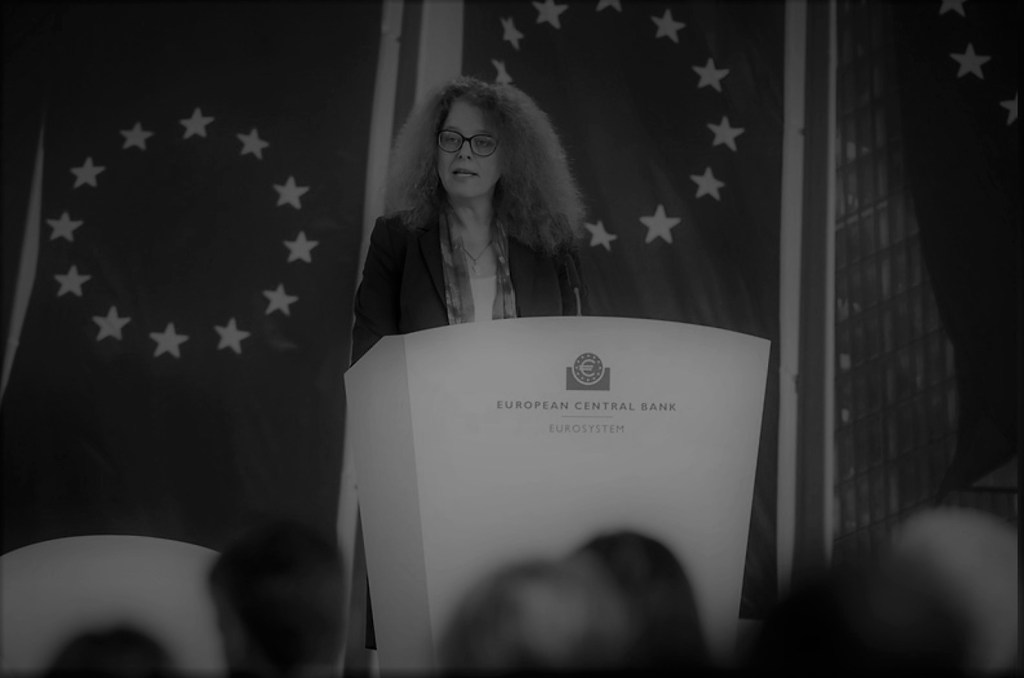
So Paul Tucker’s “Plato’s guardians in modern garb” will have to come up with some hard thinking in order to arrive at the most appropriate policy stance given the complicated circumstances with which they are confronted. In this context, the recent speech given by ECB Executive Board member Isabel Schnabel at the 8th Annual EC-EIB-ESM Capital Markets Seminar in Luxembourg offers many interesting and highly policy-relevant reflections. Schnabel will leave the ECB early next year for the IMF, where she will be the Financial Counsellor and the Director of the Monetary and Capital Markets Department.
Schnabel’s speech is especially noteworthy because she does away with the distinction often made in monetary policy considerations between demand shocks to the economy and supply shocks. More specifically, it is often argued that central banks should “look through” supply shocks and not adjust monetary policy because monetary policy cannot address the source of a supply shock. A more restrictive monetary policy cannot remove supply chain disruption, do away with protectionist trade policies, reopen the Strait of Hormuz, or end the war in Ukraine.
But, as Isabel Schnabel argues, “what matters is the effect of the shock – be it demand or supply – on the projected path of inflation… If a supply shock is sufficiently large or persistent to raise the projected inflation path above target (JVO: the ECB’s target inflation rate is 2%), the optimal response is to tighten monetary policy… The underlying mechanism… is as follows: in the absence of a policy response, higher expected inflation lowers the real interest rate and expands demand, thereby adding to the price pressures caused by the supply shock. Tightening monetary policy counteracts this effect… By restraining growth in aggregate demand, higher interest rates can limit the extent to which a relative price shock, often originating from the energy sector, can broaden into more persistent, economy-wide inflation.”
Although Isabel Schnabel takes up the defense of the recent policy decisions taken by the ECB, her analysis clearly signals that probably more of a restrictive nature is needed. “The new energy shock,” so she argues, “did not hit an economy in which all underlying inflationary pressures had disappeared, but one with some residual domestic price pressures, reflecting the delayed adjustment to the earlier inflation surge. Repeated periods of high inflation make prices more salient, increasing the attention people pay to inflation and potentially influencing how households form expectations, how workers negotiate wages and how firms set prices.”
“Her analysis clearly signals that probably more of a restrictive nature is needed.”
Some truths never die. If left uncontrolled, inflation always leads to economic and societal upheaval. It might be tempting—and that is certainly the case in the present world full of turmoil and uncertainties—to reach for inflation as a way to deal with, for example, the mounting debt overhang. Inflation might bring some consolation in the short term, but in the longer term, this approach will surely backfire and become destructive. Certainly, Paul Tucker’s “new masters of the universe” should be well aware of this reality and focus on their foremost task: safeguarding price stability. First things first.
The Schnabel Legacy (PDF)

