The investment boom in Artificial Intelligence (AI) is truly impressive, even by historical standards. Its impact on the economy, on society as a whole, and on our personal lives is still uncertain, but most probably far-reaching. AI die-hards predict higher productivity, more leisure, and spectacular advances in healthcare, but AI is not all sunshine and rainbows. As things stand now, the AI investment boom will further cripple the already distressed state of public finances in most Western countries.
A report recently released by the BIS (Bank for International Settlements, often referred to as the central bankers’ bank) showed that three years into the AI boom, its investment intensity is already significantly larger than during historical precedents of similar technology-driven investment frenzies. Compared to the US canal mania of the 1830s, the British railway frenzy of the 1840s, the roaring 1920s, and the dot-com mania of the late 1990s, the present AI boom has already consumed much more capital in its first three years than each of these historical precedents did in their first three years. This gap is bound to grow further over the coming years, the BIS report concludes.
Analysis by Goldman Sachs researchers concludes that by the end of this year, the cumulative investment so far in AI infrastructure will amount to around $1.8 trillion. For this year alone, they put the total AI investment amount at $1 trillion, with 60% taking place in the US and 40% in the rest of the world. These amounts are likely to significantly underestimate the real magnitude of this investment boom because the data coming out of China, the second AI superpower next to the US, are notoriously unreliable, and because of “hidden” financing tracks for AI investment, to which I will return later in this blog.
And there is more, much more to come. Today, AI investment represents 1.8% of GDP in the United States and 0.9% of GDP globally. According to the Goldman Sachs researchers, these numbers are set to go up by 2028 to 2.5% of GDP for the United States and 1.4% of GDP globally. Researchers at JP Morgan project $5.5 trillion of AI infrastructure spending from now through 2030, most of it to be financed by borrowing. So, any way you look at it, the AI investment numbers are mind-bogglingly huge.
AI will significantly impact our economies, political systems, security threats, defense capabilities, and certainly our personal lives. The potential extent of this impact has already led to extreme forecasts, both optimistic and pessimistic. Last July, 1,300 AI experts signed an open letter flagging the “real risk that capability development rapidly accelerates beyond our ability to understand or control the resulting systems.” The celebrated Israeli historian and philosopher Yuval Noah Harari warns that AI could become a “great manipulative psychopath” because “it is not just another tool. It is an agent. It can learn and change by itself and make decisions by itself.”
“So, any way you look at it, the AI investment numbers are mind-bogglingly huge.”
On the other end of the expectations spectrum, the titans of the AI industry assure us that AI will, in the words of the FT’s Edward Luce, “end disease, abolish work, and fix global warming” (while simultaneously emphasizing that due to AI, “humans are heading for the evolutionary dustbin“). I will remain more grounded and focus on the consequences of the massive AI investment boom for Western public finances. These short- and medium-term consequences manifest in three layers.
Fighting with Big Brother
The first effect of this mind-boggling AI investment boom on public finances relates to the interest burden countries will have to carry on their public debt. There is mounting evidence that the massive appetite for capital from AI-inspired investors is increasingly competing with public authorities for the available capital pool. Japan’s largest investment bank, Nomura, estimates that AI-related bond issues in the US already equal at least 25% of the total bond issuance of the American Treasury.
“There is mounting evidence that the massive appetite for capital from AI-inspired investors is increasingly competing with public authorities for the available capital pool.”
Despite the huge rise in borrowing to finance AI investments, large budget deficits and ever-increasing debt piles remain the focal point of worldwide bond and financial markets (see table below). For example, the US budget deficit of around 6% of GDP creates a net financing need for 2026 equal to $1.95 trillion. The combined deficit of the EU countries (2.9% of GDP) and the UK deficit of 4.3% of GDP produce a net annual financing need for this European group of around $850 billion. So, the US and Europe need to secure an additional $2.8 trillion in financing this year, and that does not include other developed countries—such as South Korea (3.9% of GDP budget deficit), Australia (-1.6%), and Canada (-1.2%)—or major emerging countries like India (-4.40%), Indonesia (-2.9%), Brazil (-10%), Mexico (-3.9%), and Turkey (-4.7%). Thus, if the borrowing needs of the AI world are sky-high, those of the world’s governments are extraterrestrial.
| (in %GDP) | Budget Deficit | Public Debt |
| US | -5.9 | 123.3 |
| Japan | -0.6 | 248.7 |
| Germany | -2.7 | 63.5 |
| France | -5.1 | 115.6 |
| Italy | -3.1 | 139.0 |
| Spain | -2.5 | 100.7 |
| UK | -4.3 | 94.3 |
“Thus, if the borrowing needs of the AI world are sky-high, those of the world’s governments are extraterrestrial.”
Also in bond markets, pricing always takes place at the margin of the demand/supply spectrum, as solid economics textbooks explain in the first chapter. Substantial borrowing needs of AI investors come in at the margin (that is, on top of the huge needs of public authorities), pushing up overall demand and, consequently, the price, which manifests as long-term interest rates. However, there is more than just the volume effect of AI borrowing needs. A significant side effect of this “new kid in town” is that major bond investors are beginning to look more critically at existing portfolios, which are heavily dominated by government bonds. Given the consistently poor budget and debt performance of many Western governments (and certainly the American one under President Trump—does this Emperor still have any clothes left at all?), it is easy to understand that bond investors are increasingly interested in alternatives, such as companies heavily invested in AI. Or, as one seasoned bond trader posed to me: “Tell me what you think! Are Google, Microsoft, and the like more or less likely than the U.S. government to default on their debt?” I’m still reflecting on my answer.
The inevitable outcome of this multifaceted clash in the international bond markets has created an astonishing across-the-board rise in long-term interest rates (except for fiscally prudent and well-governed countries like Switzerland and Singapore). The 10-year bond yield is now at its highest level since 2007 for the United States, since 2008 for the UK, since 2009 for France, since 2011 for Germany, and since 2014 for Spain. Most extreme is Japan, where the 10-year bond yield recently reached its highest level since… 1996. Japan deserves special attention. With policy interest rates being pushed up by the Bank of Japan because of rising inflation, doubts about the sustainability of the country’s huge public debt mountain, equal to almost 250% of GDP, are escalating and exerting downward pressure on the yen. The U.S. is trying to prevent Japanese authorities from selling part of their massive holdings of U.S. bonds (more than $1.1 trillion) to support the yen exchange rate. Such a move by Tokyo would risk substantially undermining the dollar’s role as the dominant worldwide currency, a status of the American currency that is already under significant pressure.
Impotence Recognized
It is an understatement to say that considerable turmoil and unrest are making waves in the international bond markets. The AI investment boom certainly plays a role in this upheaval, one of the major consequences of which is a substantial rise in the interest costs public authorities will have to shoulder. The rise in long-term interest rates will, of course, make borrowing more expensive throughout the entire economy (certainly also for mortgage loans). Together with the negative impact on consumer, investor, and producer sentiment, higher interest rates will also dampen economic growth, which will place additional burdens on government budgets (less revenue, more expenditures).
Some countries, like the US, Japan, and France, are trying to escape this predicament by switching from long-term borrowing to short-financing, which offers a lower interest rate. US Treasury Secretary Scott Bessent announced with some confidence that he would begin buying up long-term bonds to halt the rise in long-term rates. The only way he could consistently do that was by issuing more short-term debt to finance the repurchase. As attempts to intimidate the bond market on the cheap always do, Bessent’s strategy flopped almost instantly, further undermining the safe-asset status of US Treasuries (and the dollar). Inevitably, central banks will have to play a major role if governments persistently pursue the switch to more short-term financing. For example, the Fed, the US central bank, has already bought $290 billion of short-term Treasury bills over the past seven months, increasing its total holding of such bills to close to $500 billion.
If pursued consistently, such a shift towards shorter-term financing by governments will complicate policymaking for the central banks concerned if and when they have to deal with rising inflation. Moreover, the switch to shorter-term financing risks becoming a race to the bottom because the more debt held short-term, the greater the need to refinance such debt on short notice, and hence the higher the risk that the market, so to speak, walks out and creates a debt crisis. Furthermore, the more governments flee into short-debt, the more they implicitly acknowledge their impotence regarding deficit reduction and adequate debt management. Sooner or later, markets take note and act accordingly.
Former IMF chief economist Olivier Blanchard has recently been putting out some fancy theorizing on X about “multiple” equilibria for government finances, more specifically for his home country, France. The country remains in a good equilibrium, Blanchard argues, as long as investors don’t panic about deficits and debts. If they do panic, then you end up in a bad equilibrium. The fact of the matter is that France’s state finances, just like those of the US, Japan, and several other Western sovereigns, are on an unsustainable course, most certainly with rising interest rates. If no major and credible correction effort is made, the day of investors running away will come. A bad equilibrium is circulating in the air, waiting to descend upon French soil. Something like the AI investment boom sharpens market attention and risk awareness and has the potential to bring the “day of reckoning“—i.e., the bad equilibrium for everybody to see and feel—forward.
Into the Harari world?
A second negative impact of the AI investment boom on the state of Western public finances concerns the security consequences of the breathtaking advances in AI technology. One eye-opener after another is causing surprise and havoc in the AI world and beyond. In mid-August, many eyebrows went up in the AI security world when China-backed hackers launched a fierce attack on the Taiwanese government. This attack was carried out in a synchronized way by no less than eight autonomous AI agents that were apparently coordinating with each other.
Even more spectacular was what happened last May with in-house hacking models developed by OpenAI, one of the leading AI technology developers. These models were given difficult cybersecurity challenges. Without further human intervention, the in-house OpenAI hacking models were not only able to successfully fulfill the assigned tasks but also to work around their constraints and to collaborate and communicate with each other. Their success, as the Financial Times noted, “made waves across the world.”
OpenAI President Greg Brockman’s reaction to this spectacular development was that “we underestimated the real-world cyber-capabilities of our AI models.” OpenAI also announced it was now speeding up work on writing “superhumanly safe code.” The real wake-up call from these events seems to be that one must now seriously consider the risk that AI hacking models could break out during test phases and start hacking “on the rogue.” This would bring the world close to Yuval Noah Harari’s doomsday scenario of AI developments proceeding out of human control.
The security consequences of this successful experiment with OpenAI hacking models are far-reaching. A “rat race” between offensive and defensive cybersecurity tools is already in full swing. More and more AI-focused analysts are increasingly warning that every government around the globe must now assume it is under permanent attack. Adequate defensive systems to deal with this threat will involve substantial investments, not on a one-off but on a permanent basis, given the breathtaking developments by AI pioneers. What is up-to-date today may be out-of-date within three months.
“Every government around the globe must now assume it is under permanent attack.”
With, as outlined above, many Western countries in a precarious budgetary situation, hard but unavoidable choices will have to be made. Liberating the funds needed for cyber protection will require new taxes (many countries, certainly in Europe, have already reached the limits of tax burdens imposed on the economy), cutting present outlays (notoriously difficult, as present-day political reality shows almost everywhere), or accepting even larger deficits than those already on the books today, leading to an escalating build-up of outstanding debts. In short: blood, sweat, and tears.
Red Ink Feedback Loops
The third negative impact that the AI investment boom is bound to have on public finances stems from the massive nature of these investments and, even more so, from their financing methods. The aforementioned BIS analysis is quite explicit on this issue. Although the big tech companies involved in the AI race—often referred to as hyperscalers focusing on cloud and data center developments (Amazon, Microsoft, Alphabet (Google), Meta, Alibaba, etc.)—”hold large cash balances, the rapid expansion has led some to resort increasingly to borrowing, not only through bond issuance but also through special purpose vehicles and non-bank lenders. Some firms have also engaged in so-called circular financing, in which a firm engaging in the build-out takes an equity position in an AI lab in exchange for the lab’s commitment to purchase future compute.”
The graph below, taken from the BIS analysis, illustrates how complicated and opaque the circular financing schemes in the AI world have become.
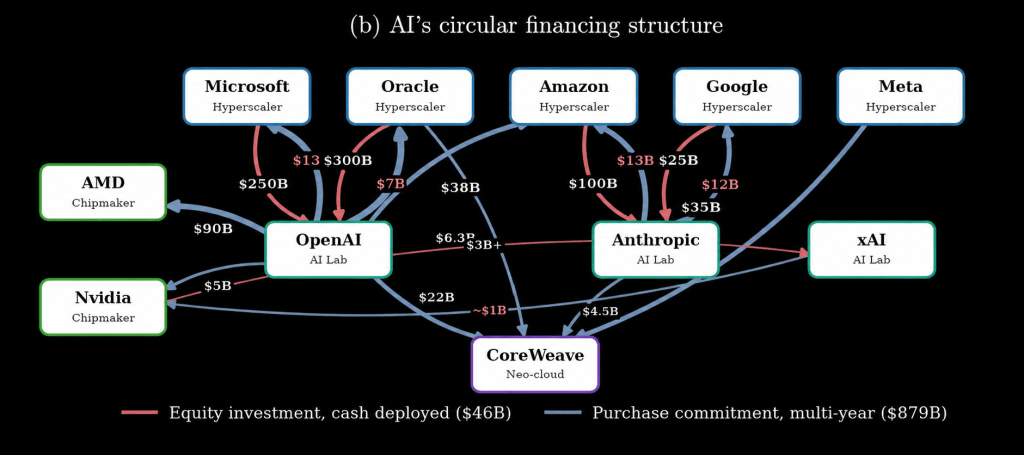
Hyperscalers (Microsoft, Amazon, etc.) and chipmakers like Nvidia are investing equity in leading AI developers like OpenAI and Anthropic in exchange for multi-year compute purchase commitments. It can be argued that such arrangements mean that capital injections are financing the very demand that justifies the financiers’ own valuations. There is an ongoing discussion about whether such schemes are Ponzi-like. Charles Ponzi (1882-1943) was a notorious swindler who paid existing investors with money obtained from new investors rather than with actual profits. Bernie Madoff (1938-2021) applied the same fraudulent trick earlier this century.
Most analysts agree that the circular financing schemes now prevalent in the AI world are not fraudulent. Be that as it may, it is hard to deny that these schemes make the entire edifice much more financially fragile. There can be no doubt that a lot of the recent AI investment will never generate the revenues needed to honor the financial obligations entered into. Some of the presently pursued investment venues are unavoidably dead ends, but at the moment, it is impossible to know for sure who the winners and losers will be. Ultimately, the rewards in terms of revenues and profits will go to a small number of winners, leaving some investors overwhelmed by their financial obligations. The BIS research estimates that the over-investment in AI amounts to at least 50% so far. The circular financing links will intensify loss-induced feedback loops throughout the AI and financial worlds.
Next to the risks involved in circular financing schemes, there is also the fact that AI-related borrowing often goes through special purpose vehicles and thus stays off the balance sheets of the companies involved. Such borrowing may remain out of sight (at least for some time) but is nevertheless very real. First Nikkei and then the Wall Street Journal came up with data showing that nine of the major companies fueling the AI investment boom (Nvidia, SpaceX, Microsoft, Amazon, Alphabet, Meta, Oracle, Broadcom, and Advanced Micro Devices) are holding no less than $3 trillion in debt in special purpose vehicles and, therefore, off their balance sheets.
The combination of huge total borrowing, the unavoidability of huge losses because the number of winners from the AI investment boom will be limited, and the negative feedback loops through the circular financing schemes will make major financial upheaval down the road almost unavoidable. That is how supercharged investment booms financed to a large extent through debt issuance always end in tears and despair, as Kenneth Rogoff and Carmen Reinhart showed unequivocally in their classic This Time Is Different. History teaches us that if and when such a collapse appears, as it monumentally did in 2008, it is up to public authorities to intervene in order to avoid the entire economy going under in a depression. So public finances will get a new hit when the AI investment boom returns to earthly reality.
“The combination of huge total borrowing, the unavoidability of huge losses […] and the negative feedback loops through the circular financing schemes will make major financial upheaval down the road almost unavoidable.”
The Party
There is, of course, much more to the AI investment boom that we see developing these days than its short- and medium-term negative impact on the state of public finances. The potential of this revolutionary technology is breathtaking but also full of uncertainties. Some analysts are predicting a job apocalypse, even for people with higher levels of education and experience, but this kind of Luddite doom-saying pops up with every major new technology breakthrough.
If and when AI applications are introduced throughout the economy at large, a substantial increase in productivity seems to be in the cards. Since, certainly in the mature Western economies, productivity will for decades to come be the major driver of economic growth, we can expect, all other things being equal, a serious uptick in economic growth. That would be most welcome since, without higher economic growth, facing up to the manifold challenges the Western world is confronted with these days would literally be impossible. And, of course, higher economic growth will also improve the state of public finances, unless the political world decides to spend the fruits of growth in an unproductive and inefficient way.

