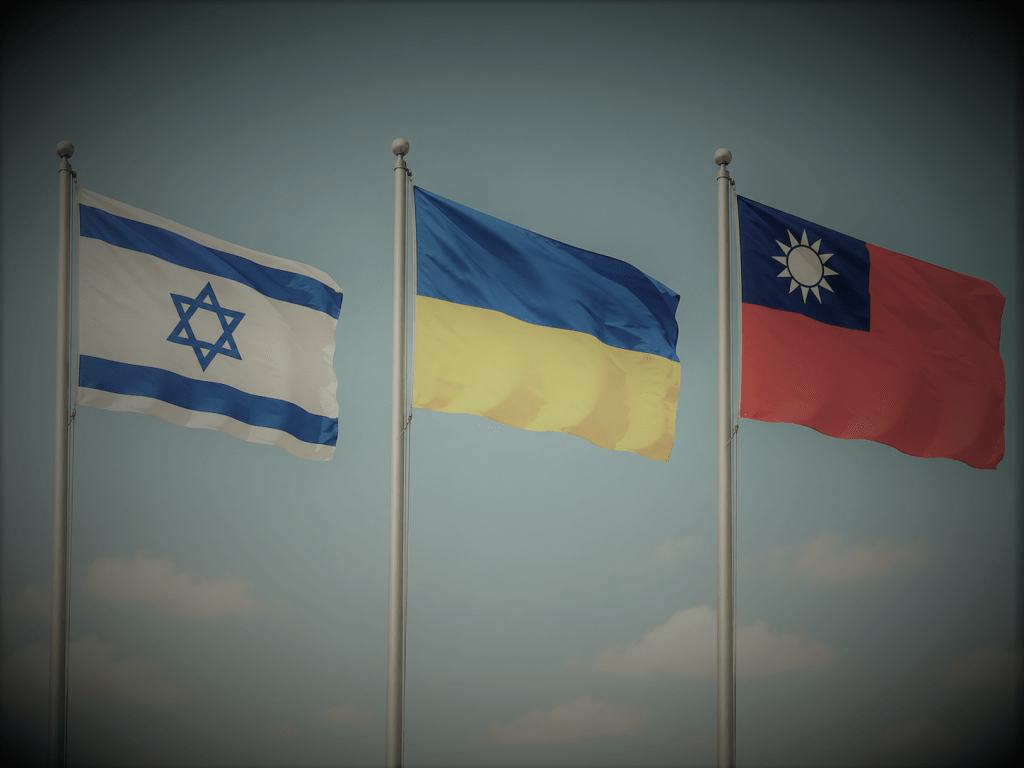
In the shadows of the great power struggle between the United States, China, and Russia—with India and the European Union at one remove—impactful developments are unfolding among not-so-great but increasingly relevant powers. More specifically, events in and around Ukraine, Taiwan, and Israel are having a major impact, not least on the great power struggle itself.
Anyone looking for an excellent treatise on how geopolitical power is shifting in our turbulent times should ensure that Brendan Simms’ The Return of the Great Powers (2026, Basic Books) becomes part of their holiday luggage. Simms is a professor in the history of international relations at the University of Cambridge, UK. He not only presents an insightful description of what truly constitutes a great power and an eloquent history of how great powers and their mutual relationships evolved over time, but he also delves deep into the present-day evolution of the great powers’ struggle. The book obviously focuses on the United States, China, and Russia, with interesting and often revealing comments on how India, Japan, the European Union, the UK, Germany, and France fit into the picture. The Return of the Great Powers is an extremely well-documented book, written in very accessible language, and full of great insights and analyses.
Brendan Simms, however, misses—if I may say so as a humble observer of geopolitics—one crucial ingredient of the rather chaotic geopolitical turmoil we see developing in today’s world. Moving deftly between the trajectories mapped out by the great powers, as masterfully treated in Simms’ book, are three smaller countries that are carving out a unique position for themselves in the new (dis)order of things that is in the making. I am referring here to Ukraine, Israel, and Taiwan. It would be truly exaggerated to describe these three as great powers, but each of them, in its own way, is building a societal and security model that gives them an increasingly peculiar and also powerful place in the world at large. Their impact on what is happening in their regional environment is even becoming decisive.
On Their Own
What the three countries just mentioned have in common is that each is faced with a ferocious enemy intent on destroying their existence as we know it today. Russia wants to enslave Ukraine and do away with the democratization process started in Kyiv. Iran and its acolytes in the Middle East (Hamas, Hezbollah, the Yemeni Houthis, etc.) are absolutely unequivocal about their intent to wipe the state of Israel off the face of the earth. The People’s Republic of China cannot tolerate the existence of an independent and democratic Taiwan and is fanatically determined to retake the island. Ukraine, Israel, and Taiwan are vastly outnumbered by their enemies and, so it seemed until recently, also clearly outgunned.
Things are, however, working out differently, basically on the basis of sheer willpower, creativity, and technological developments fundamentally reshaping the characteristics of 21st-century warfare. It is the pronounced feeling of “loneliness”—”On whom can we really count?” policymakers in Kyiv, Tel Aviv, and Taipei are increasingly asking themselves when push comes to shove—that is driving the success of each of these three beleaguered countries. Apparently, extraordinary creativity and willpower emerge when the realization sinks in that one basically has to take one’s destiny into one’s own hands, relying on one’s own potential and resilience.
Modern technologies, not least the developments in the field of artificial intelligence (AI), seem to be very helpful in allowing these highly motivated states and their citizens to develop capabilities that allow them to “go it on their own.” Of course, Ukraine, Israel, and Taiwan would still be in a more or less awkward situation were it not for Western support, especially American support for the military and security forces of these three countries. But the degree of dependency is definitely declining.
“Extraordinary creativity and willpower emerge when the realization sinks in that one basically has to take one’s destiny into one’s own hands, relying on one’s own potential and resilience.”
Forget the Numbers
The most straightforward case is that of Israel. The organizational and technological superiority of this country’s armed forces and intelligence network is nothing short of jaw-dropping. During the recent war in the Middle East, the Iranian armed forces, and especially the air force and air defense systems, were no match at all for the Israeli onslaught. It is also very noteworthy that large parts of the manifestly underperforming Iranian air defense systems were “made in China,” a fact of life that is making a lot of people quite nervous in Beijing, to say the least. The spectacular capture of the Venezuelan dictator Maduro by American commandos could also not be prevented by the truckloads of Chinese military material available to the Caracas regime.
Of course, the American input into the war on Iran was considerable, but even without that assistance, the Israeli war machine would undoubtedly have had the upper hand in the fight against Iran and its acolytes. Israel is still very dependent on American military and financial support, but internal R&D efforts and constant innovation are reducing this dependency day by day. It is certainly in the field of military and security technology that Israel fully deserves the description as THE start-up nation.
The feverish drive for innovation and the development of new technological capabilities is driven by the recognition of the fact that one day they will only be able to survive as a state if and when they can assure that survival on the basis of their own strengths. This basic attitude allows the country to hold back, and even dominate, an enemy that is firmly supported by China and Russia and that can line up at least ten times as many soldiers and associated fighters as Israel is able to. Israel’s technological lead and persistent advances more than make up for the huge disadvantage in numbers.
“Israel’s technological lead and persistent advances more than make up for the huge disadvantage in numbers.”
Vladimir al-Baghdadi
The case of Ukraine is probably the most astonishing of the three. When Vladimir Putin launched his full-scale military invasion of Ukraine, he and most Western observers took it for granted that the mighty Russian army would easily overwhelm the shabby Ukrainian army and get the job done in a few weeks’ time. That turned out to be a huge mistake because of the massive Western support for Kyiv, the chaotic and disorderly behavior of the Russian army plagued by massive corruption, and most of all because of the brave and creative resistance of the Ukrainian army and intelligence services. The Ukrainians have to a large extent turned the tables on the Russians.
On the basis of homegrown developments in drone technology and hardware and air defense systems, the Ukrainians are not only able to better protect their country against the Russian onslaught but are even increasingly able to attack inside Russia. Moreover, these Ukrainian attacks are, with the assistance of American intelligence, surprisingly accurate and pointed towards military and energy infrastructure. The Russians, on the other hand, are, probably out of sheer desperation, reducing themselves to clones of Al Qaeda and ISIS. The Russian attacks on Ukraine are indeed increasingly meant to just sow terror and kill as many civilians as possible, a sharp contrast with the nature of the Ukrainian attacks on Russia. Vladimir Putin increasingly looks like the Orthodox Christian version of Abu Bakr al-Baghdadi.
“On the basis of homegrown developments in drone technology and hardware and air defense systems, the Ukrainians are not only able to better protect their country against the Russian onslaught but are even increasingly able to attack inside Russia.”
As a consequence of the persistent Ukrainian resistance and the successful attacks inside Russia, there is increasingly talk of a domestic meltdown in Putin’s Russia. The endless stream of body bags and missing persons (at least eight Russians killed for every Ukrainian victim), the lack of any geographic progress on the battlefield (even on the contrary), the fuel crisis resulting from the Ukrainian bombing of the energy infrastructure, the desperate situation in Crimea, Putin’s increasingly paranoid behavior, the blatant corruption coming out in the open, the manifest continuous lying by the president and his clique, and the apparent lack of efficiency of the Russian air defense systems are all visible signs of that meltdown. It inspired Canada’s prime minister Mark Carney to bluntly declare that “Russia is losing the war.” American officials describe Russia’s offensive capabilities as “approaching zero.” Even President Trump, always on the lookout for winners, seems to have changed camps and is now praising Zelensky and allowing the Ukrainians to produce Patriot missiles.
Despite their heroic resistance and remarkable technological advances, Ukraine is still very dependent on Western support, financially as well as militarily. For example, American Patriot missiles are still indispensable in the defensive arsenal of the Ukrainians. But also for the Ukrainians, the degree of dependency is declining, most certainly so in the military field. It is no secret that even the military top brass in the United States are most interested in the new drone and related technologies continuously developed by the Ukrainians.
David
The most desperate case of the three countries surveyed here seems to be Taiwan. The island 100 miles off the coast of mainland China is faced with a determined, well-armed, and massively mobilizing opponent. Under the leadership of Xi Jinping, the PRC (People’s Republic of China) has become more than ever determined to retake the island of Taiwan and make it fully part of mainland China’s political and economic system. If ever there was in geopolitical terms a David-facing-Goliath standoff, this is it.
Taiwan has, however, over the past years been building up remarkable defense capabilities of its own in the context of the so-called “porcupine strategy,” focusing on asymmetric warfare capacities. In a recent US Congress report, this strategy was described as building “capabilities intended to cripple an amphibious invasion through a combination of anti-ship missiles, naval mines, and other small, distributable, and inexpensive weapon systems.” Among the most relevant in-house Taiwanese developments are high-tech drones like the Albatross II, miniature assault boats, and fast mine-laying ships. Like Ukraine and Israel, Taiwan is still very much dependent on American military supplies and intelligence assistance, but also to a diminishing extent.
While there can be no doubt about the overwhelming dominance of China in terms of manpower and military hardware, the Taiwanese defense capabilities are such that if Xi’s regime were to decide on a military invasion of Taiwan, it risks a huge number of casualties, the prospect of a prolonged conflict (cf. Putin’s dream to end the Ukrainian conflict in a few weeks’ time), and political and diplomatic isolation.
Small but Strong
Israel, Ukraine, and Taiwan are faced with opponents against which, according to standard military analysis, they don’t stand much of a chance. Each of these three countries has been able to hold the line thanks to Western and, most of all, American support. But each of them has over time realized that they needed to be much more dependent on their own intrinsic strengths. The realization of this necessity gave birth to strong determination and impressive innovations in military and security technology.
Israel, Ukraine, and Taiwan play an outsized role in today’s chaotic geopolitical environment. When each of the major powers does their math and develops their strategies, these three countries enter into the equations in a meaningful and structural way. Not least thanks to the specifics of new technologies (most notably AI), smaller but determined countries can increasingly stand on their own feet, thereby complicating the calculus and room for maneuver of the great powers.
“Smaller but determined countries can increasingly stand on their own feet, thereby complicating the calculus and room for maneuver of the great powers.”
 Johan Van Overtveldt