
“France,” the Financial Times recently concluded, “replaces Italy as European bond investors’ biggest worry.” Persistently large budget deficits and political quasi-ungovernability are indeed fundamentally undermining Paris’s creditworthiness. While crackpot ideas about debt cancellation circulate, the ECB watches attentively in the shadows. However, the cross-border transfers its policies provoke could become a major stumbling block.
“Les extrêmes se touchent” (extremes meet), as a well-known, at least in French, political quip goes. In France, warming up for the presidential elections of April 2027, the truthfulness of this quip is being proven by the extreme right and the extreme left with their positions on what to do about the rapidly escalating French public debt. They suggest simply having the central bank—whether it be the European Central Bank (ECB) and/or the Banque de France—cancel the French debt on their balance sheet in one way or another.
It was Jordan Bardella, president of the far-right National Rally since 2022 and currently a member of the European Parliament, who fired the opening shot on this topic at the end of 2025. In several interviews, he floated the idea that the ECB could buy back French debt, thereby bringing down interest rates on that debt. The suggestion landed on deaf ears in Frankfurt. On August 25 of this year, Jean-Luc Mélonchon, the presidential candidate of the far-left party La France Insoumise (France Unbowed), launched a closely related idea: that the ECB should simply cancel the French debt already on the Eurosystem’s balance sheet.
“The suggestion landed on deaf ears in Frankfurt.”
The Eurosystem comprises the ECB and the national banks of the euro area’s member states (including the Banque de France). Investment banker and sympathizer of La France Insoumise, Mathieu Pigasse, intervened to support Mélonchon’s suggestion. It appears the Frankfurt bank will not even bother to react to this Mélonchon-Pigasse “outing.” Not exactly in line with what he himself proposed earlier, Jordan Bardella described the Mélonchon proposal as “nonsense.” So much for any semblance of coherence.
Debt Champion
Total French public debt now stands at 3.5 trillion euros, or close to 120% of GDP. 600 billion euros of French public debt sits on the Eurosystem’s balance sheet. The French government budget ended 2025 with a deficit equal to 5.1% of GDP, a little smaller than the 5.8% in 2024 and closely in line with the 2023 and 2022 deficits (5.4% and 4.7% of GDP, respectively). The European Commission forecasts a deficit equal to 5.1% of GDP again for this year. With a stalemate in the French political world as a consequence of President Macron’s failed gamble with the snap elections of June 2024, there is no chance of having a credible budget proposal that will significantly reduce this deficit next year. Prime Minister Sébastien Lecornu intends to present his draft 2027 budget on September 30.
With very feeble economic growth (0.8% in 2025, matching this year’s forecast) and a spectacular rise in French long-term interest rates (from virtually 0% at the start of 2022 to over 4% today, the highest level since 2007), the evolution of French public debt risks becoming explosive due to an interest rate snowball effect. Forward-looking spreads over German interest rates clearly express this fear. The 15-year forward spread for France tripled between 2021 and today (from 50 to 150 basis points). “France is not far off Eurozone debt crisis levels of risk premium,” commentary at Fidelity International, a top investment management company, recently concluded.
It should also be noted that France registers a very high overall debt level, combining the debt of government, households, non-financial corporations, and the financial sector. According to the Global Debt Monitor of the Institute of International Finance, the French overall debt burden stood at 427% of GDP at the end of the third quarter of 2025, significantly higher than the corresponding numbers for the euro area (353%) and the United States (333%). Unsurprisingly, Japan finds itself at the top of this overall debt league with 576% of GDP. In times of crisis, history tells us, private debt tends to a substantial degree to become public debt.
The Argentinian Track
Given the state of French public finances and its economy in general, it should not be a surprise that some more extreme, not to say crackpot, ideas on what to do with the escalating debt mountains are starting to circulate. The whole debt cancellation idea is indeed crackpot policy launched by politicians ready to risk everything for the sake of electoral gains. It would damage France’s reputation for a very long time to come and make France pay a substantial extra risk premium on every new offering of public debt. Everybody will ask what the French state’s signature is really worth. Holders of French public bonds will wonder aloud when it’s their turn to pass through the debt cancellation merry-go-round.
“The whole debt cancellation idea is indeed crackpot policy launched by politicians ready to risk everything for the sake of electoral gains.”
If nothing fundamental is done about the annual budget deficit and no courageous reforms are pushed through to stimulate economic growth, public debt will start going up again the day after cancellation. But if serious deficit reduction and credible growth stimulus are executed, market confidence will immediately return, interest rates will ease, and the need for debt cancellation will disappear. It is a vicious circle: debt cancellation is asked for by those refusing structural deficit reduction and fundamental reforms. In short, debt cancellation pushes a country onto the Argentinian track, paved with serial defaulting resulting in economic decline, social upheaval, and political disarray.
“If serious deficit reduction and credible growth stimulus are executed, market confidence will immediately return, interest rates will ease, and the need for debt cancellation will disappear.”
A debt default scheme for France would fundamentally endanger the European monetary union, which might be the extreme parties’ ultimate but unspoken goal. The process leading to debt default would irreparably damage the entire euro construct. Several other member states, facing huge public debt and political difficulties in controlling public finances—it is broadly known which member states I am referring to—would demand similar treatment. Conversely, other countries—again, it is broadly known which member states I am referring to—will fight any debt cancellation initiative tooth and nail. The still-unfinished house of the euro would shake to its very foundations.
“The process leading to debt default would irreparably damage the entire euro construct.”
Transfer Nightmare
It is quite likely that in such a context, the rather invisible but nevertheless very real transfer mechanism linked to ECB policies will further cloud the atmosphere. The cross-border transfers resulting from unconventional monetary policies such as QE (Quantitative Easing) came to light thanks to impressive research by Hanno Lustig of Stanford University’s business school and his colleagues. The basic mechanism behind these transfers consists of the ECB funding “its balance sheet expansion mostly by issuing bank reserves and cash in core countries. The national central banks (NCBs) in periphery countries then borrow from the core NCBs at below-market rates and use these funds to finance asset purchases and bank lending.”
The core consists of countries such as Germany and the Netherlands, while the periphery includes countries such as Italy and Spain, and increasingly France as well. Lustig & Co. conservatively calculate that between 2004 and 2023, Spain, Italy, and France received a cross-border subsidy equal to 7.2%, 6.0%, and 0.8% of their GDP, respectively. Germany, on the other hand, paid cross-border subsidies to other Euro area countries, primarily the periphery countries, equal to 10.7% of GDP over the same period.
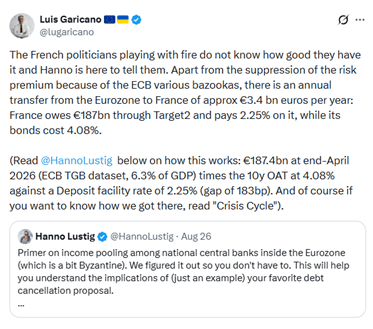
Based on the Lustig & Co. methodology, Luis Garicano, currently at the London School of Economics and a former member of the European Parliament, calculated an annual transfer from the Eurozone core to France of approximately 3.4 billion euros per year. Luis Garicano states: “France owes 187 billion euro through Target 2 and pays 2.25% on it, while its bonds cost 4.08%.” Target 2 balances are cross-border loans provided from one national central bank in the Eurosystem, via the ECB, to another national central bank. To a large extent, they arise from the financing of current account deficits. Countries like Italy, Spain, and France owe substantial amounts through the Eurosystem to surplus countries like the Netherlands and, most notably, Germany.
As Minister of Finance from 2014 to 2018, I lived through the final phase of the Greek crisis. The euro’s survival was a close call then; it will be even more so, to put it mildly, if and when larger member states endure the same hellish experience in a global economic context far more complicated and demanding than it was back then. The crises the Eurosystem will need to manage will be, say, ten times (perhaps even more) larger than those at stake during the Greek crisis.
At this point, it is quite evident that the debt cancellation suggestions from French political extremes have no chance of becoming the official policy of European political and monetary authorities. A major reason to be confident in this prediction, despite increasing turmoil in bond markets and the precarious public finance situation of several euro area member states, is the ECB’s toolbox for dealing with major debt crises within the euro area. I am referring more specifically to the ECB’s TPI program.
The TPI
In mid-June 2022, amidst the ECB’s belated awakening to rapidly escalating inflation, spreads on Italian bonds rose to 250 basis points (from only 130 basis points at the end of 2021). Italy’s already precarious public finances were on the brink of becoming explosive. Given that rising inflation made it absolutely necessary for the ECB to stop its quantitative easing program (i.e., buying significant quantities of member states’ bonds), the ECB had to confront a potentially pressing problem. What should it do if spreads between German and Italian bonds (and potentially those of other high-debt/large-deficit member states) were to escalate further, risking the start of a new euro area debt crisis?
A special meeting of the ECB’s Governing Council was called. During that meeting, a new “Anti-Fragmentation Instrument,” labeled the Transmission Protection Instrument (TPI), was decided upon. ECB President Christine Lagarde explained that such an initiative was needed to ensure that “repricing” in the bond market “is not exacerbated and distorted by destabilizing market dynamics leading to fragmentation of our original policy impulse.” In its press release of July 21, 2022, the ECB further explained that within the TPI, “the Eurosystem will be able to make secondary market purchases of securities issued in jurisdictions experiencing a deterioration in financing conditions not warranted by country-specific fundamentals… The scale of TPI purchases would depend on the severity of the risks facing monetary policy transmission. Purchases are not restricted ex ante” (my italics).
The TPI program is problematic for three reasons. First, there is the moral hazard problem. The program’s existence and potential activation at any time might delay adequate action by individual member states in terms of deficit reduction and debt containment. A former ECB president once famously declared that the ECB would do “whatever it takes” to safeguard the euro. Many national capitals likely assume that preventing the default of a (large) member state falls within the scope of “whatever it takes.”
“The program’s existence and potential activation at any time might delay adequate action by individual member states in terms of deficit reduction and debt containment.”
Secondly, it is notoriously difficult to determine whether increases in country-specific interest rates and spreads are caused by fundamental macroeconomic disequilibria or by “destabilizing market dynamics.” To decide on activating TPI, the ECB’s Governing Council will assess “a cumulative list of criteria” to evaluate the soundness and sustainability of fiscal and macroeconomic policies. One could argue that this framework creates constructive ambiguity to be used judiciously by responsible policymakers. However, given the political reality of crisis moments, this argument sounds naive, if not unrealistic.
The ECB and the Eurosystem, in general, do not lack highly intelligent and creative people perfectly capable of twisting and turning the available evidence to detect “destabilizing market dynamics.” Policymakers in national capitals, if they are worth their pay and position, are aware of this reality, which reinforces the moral hazard point made above. More generally, the judgment on the state of government policies is ultimately always a political judgment. The rule for central banks is that when they meddle with politics, politicians will meddle with them. The much-needed independence of the central
bank, especially in the eurozone context, will then be in grave danger.
“The rule for central banks is that when they meddle with politics, politicians will meddle with them.”
Third, there is the question of why TPI had to be launched when the OMT program is still in the ECB’s toolbox. OMT, or Outright Monetary Transactions, is a program installed during the euro crisis to allow the ECB to buy government bonds of euro member countries experiencing financial difficulties. The OMT program enabled the ECB to deviate from the capital key condition when buying member states’ bonds. The capital key condition requires the ECB to buy bonds strictly in proportion to each member state’s share in the ECB balance sheet capital. This condition was introduced to avoid fiscal redistribution through ECB interventions.
The OMT program required, and still requires, strict conditionality, meaning that countries eligible for OMT support would have to accept a stabilization program as outlined by the European Stability Mechanism (ESM). Then-ECB President Mario Draghi argued that this conditionality was absolutely necessary because, otherwise, the ECB’s support through its interventions would undermine governments’ incentives to take decisive actions on the budget deficit. With TPI, the conditionality of an ESM program is severely weakened, as argued above. That weakening must have been a major driver to launch TPI because if weakening incentives was not the motivation, then OMT would have been perfectly suited for the job.
To conclude, we should not pay attention to the crackpots clamoring for debt cancellation. These days, they are most audible in France, but similar ideas also circulate in some other euro area member states. Much more likely in the event of developing debt crises is the activation by the ECB of its TPI program in an effort to calm and stabilize markets. The risks involved in such interventions are, as indicated above, manifold and substantial. All the more reason for member state governments to be very serious about putting their financial house in order.

