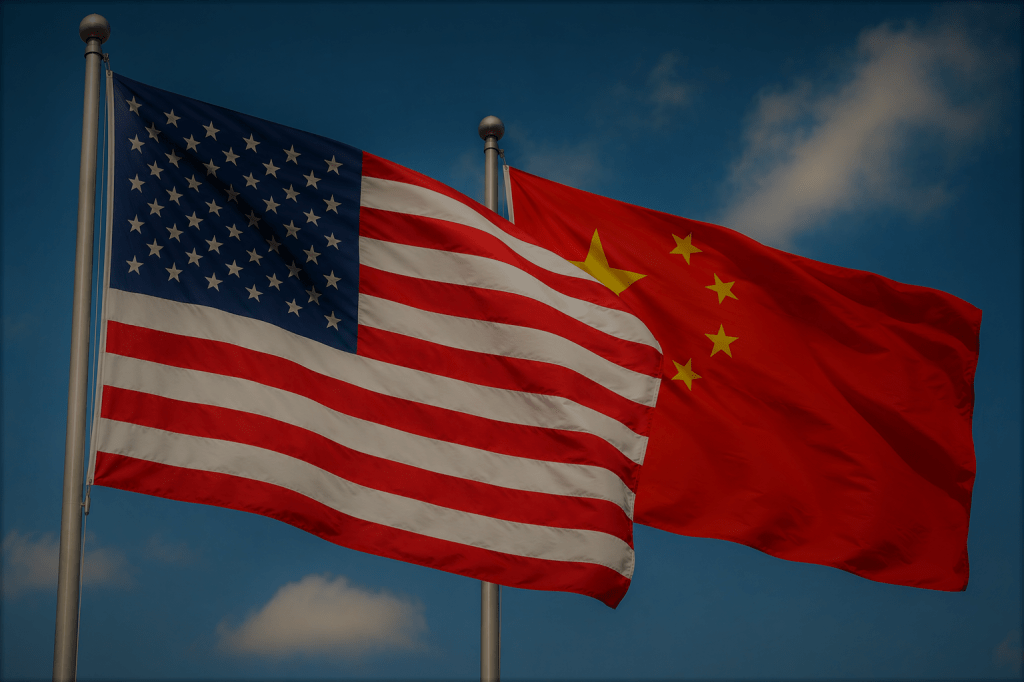
“The U.S. is out and China in” appears to be the mainstream thought in Europe. While Trump is not endearing the U.S. to most parts of the world, it would be a huge mistake not to recognize the U.S. for what it is and will remain for the foreseeable future: a real superpower. Here’s why.
It is increasingly becoming fashionable in Europe to dismiss everything out of hand when the United States is the topic of discussion—which, unfortunately, it is far too often for our own good. First comes a vitriolic condemnation of the behavior, language, attitude, and policies of President Donald Trump. That outburst is usually followed by the assertion that the heyday of American power and influence is long gone, often spiced with a hefty dose of Schadenfreude.
While there is certainly much to be said for the first part of the discourse—although one sometimes gets the impression that the bewildering ways of the American president at times serve as a smokescreen for some underlying strategy—we had better think twice about the second part of the typical present-day European critique of the United States. For at least five reasons, one had better not yet count out Uncle Sam as a superpower, maybe even the superpower.
“It would be a huge mistake not to recognize the U.S. for what it is and will remain for the foreseeable future: a real superpower.”
Trump card
The first of these five reasons is its degree of self-reliance in terms of energy needs. Largely thanks to shale oil and gas developments, the U.S. has been a net total energy exporter since 2019. The U.S. is self-sufficient in natural gas and coal. The country imports some heavy crude oil but has substantial surpluses in lighter crudes. Thus, in terms of basic energy needs, the United States can keep its economy going, regardless of events on the world stage or escalating conflicts. Of course, a modern economy is not only dependent on the availability of sufficient energy resources, but without them, any economy will definitely be in big trouble.
China has reached an 80% self-sufficiency in energy. Beijing is largely self-reliant in coal (a resource with significant CO2 emissions) and is expanding its renewable energy capacity. The country is, however, dependent on imports for over 70% of its crude oil and more than 40% of its natural gas. The EU has the weakest position of the three concerning energy self-reliance. 58% of the EU’s energy needs must be imported. While the Union has substantial inland energy production based on renewables and nuclear power, its oil and gas needs must be almost entirely met by imports. The dependency of China, and even more so of the EU, on imported oil and natural gas will continue for many years despite all efforts to eliminate it. The US’s total self-reliance on crude oil and natural gas offers Washington important strategic trump cards in the international geopolitical power game unfolding today. The situation in and around the Strait of Hormuz has proven this point unequivocally. Continuous trouble in and around the Strait is a problem for the US—rising domestic energy costs are politically costly—but a disaster for China and the EU.
“Continuous trouble in and around the Strait is a problem for the US—rising domestic energy costs are politically costly—but a disaster for China and the EU.”
Blood in the streets
Secondly, the rapid escalation of overall debt worldwide also puts the US in a better position than China and the EU. To elaborate briefly on the overall debt situation, I will refer to data from the Global Debt Monitor of the Institute of International Finance (IIF). Data collected by the Bank for International Settlements (BIS) confirm the trends evident in the IIF data. Worldwide overall debt has reached unprecedented peacetime levels since the Covid pandemic, making debt-fueled financial crises more likely and threatening to destabilize the real economy.
“Worldwide overall debt has reached unprecedented peacetime levels since the Covid pandemic, making debt-fueled financial crises more likely and threatening to destabilize the real economy.”
As of the end of 2025, overall debt—comprising government, household, corporate, and financial sector debt—stood at 549.4% of GDP in Japan, the highest ratio worldwide. The US ratio was 333.4%, with China slightly higher at 336.9%. As with most official Chinese data, these numbers need to be treated carefully. While economic growth data from China increasingly show signs of overestimation, debt data suggest underestimation. The real debt burden weighing on the Chinese economy is almost certainly much higher than the official data show. The euro area’s overall debt burden stood at 350.1% of GDP at the end of 2025, with France topping the euro area list at 424.2% of GDP. So, with the caveat concerning the Chinese data taken into account, the Big Three are relatively close to each other in terms of their overall debt ratios.
How can it then be concluded that the US is in a relatively better position than either China or the EU? Apart from the fact that American debt is entirely denominated in its own currency, the American system has a proven ability to deal with debt overhangs better than the other two major economies. As a matter of historical fact, the United States became the world’s foremost economy through a trajectory laden with debt, debt overhangs, and debt crises. Books like Christopher Walen’s Inflated. How Money and Debt Built the American Dream (2017) and Louis Hyman’s Debtor Nation. The History of America in Red Ink (2012) document this trajectory extensively.
Along this debt infested highway, US authorities, through much trial and error including significant mistakes (like during the 1930s), developed a highly efficient approach to dealing with the inevitable excesses of a debt-driven economy. The famous Chapter 11 legislation allows for a temporary halt in creditor collections, a reduction in payment amounts, and a rewriting of unfavorable contracts. Chapter 11 is mostly used by larger economic entities, but Subchapter V of Chapter 11 is intended for use by smaller businesses to reorganize their debt. Chapter 13 offers individuals the opportunity to reschedule their debt.
Furthermore, it is broadly accepted in the US that debt overhangs create “blood in the streets.” The American approach is to quickly reach a situation that allows economic activity to continue despite the “blood in the streets.” The mentality is: “Get up, the past is the past, take responsibility for your personal situation, and get going again.” True, many individuals crack under this relentless pressure, but simultaneously, an environment is created in which entrepreneurship is a dominant force.
Reluctance to Confront Debt
In Europe, we tend to be much more reluctant to let the guillotines of debt overhang fall. We protect, try to delay, seek compromises, look for cushions, and don’t hesitate to kick the can down the road, often resulting in even more debt being created. The economy tends to struggle longer with the consequences of over-indebtedness if these “ulcers” are allowed to contaminate the environment for too long. More or less the same is happening in China. The Beijing regime is averse to anything that might shake the country’s stability and create anger among the population. Thus, everything is done to avoid “blood in the streets,” leading to similar consequences as seen in Europe.
“In Europe, we tend to be much more reluctant to let the guillotines of debt overhang fall.”
Still on top
A third source of continued American strength resides in the country’s currency: the dollar. Since discussions of a potentially provocative second presidential term for Donald Trump began, the concept of global de-dollarization appears ever more regularly in analyses of the evolution of the international financial system. De-dollarization entails not only a significant reduction in the use of the American currency in world trade, investment projects, and financial transactions, but also a downgrading of its role as an international reserve currency through, for example, a reduced share of the dollar in central bank reserves. While there is indeed a slight drop in the dollar’s share in global trade and central bank reserves, and while the loss of the US triple-A status should not be taken lightly by the Washington elite, the dollar is, however, more dominant than ever in financial transactions worldwide.
The reason for this somewhat reduced yet still quite impressive dominance of the dollar is simple: at the moment, there is no real alternative. This point is extensively argued by, among others, Ruchir Sharma (chair of Rockefeller International, in a recent Financial Times op-ed), acclaimed economic author Paul Blustein (in his book King Dollar: The Past and Future of the World’s Dominant Currency [2025]), and Brendan Greeley (former Financial Times US economics editor, in The Almighty Dollar: 500 Years of the World’s Most Powerful Money). At first glance, the euro and certainly the Chinese currency, the renminbi, should be attractive alternatives to the dollar. Upon closer inspection, however, they are not really up to the job.
Prerequisites for a Global Currency
Several conditions must be met for a currency to become a leading international currency. Not only must its financial markets be deep and very liquid, but the country’s current and capital accounts also need to be open, and unconditional convertibility of the currency must be guaranteed. Beyond these conditions, a leading international currency cannot function without an effective legal system underpinned by a trustworthy and proven rule of law. None of these conditions is fulfilled for the Chinese currency. Hence, there is an easily understandable hesitancy within the international financial and economic community to upgrade the renminbi to the status of a leading international currency, despite the spectacular rise of the Chinese economy on the world stage.
No wonder, then, that the Federal Reserve’s index, which measures how heavily major currencies are used globally in trade, currency, debt, and other transactions, shows that the renminbi’s share has climbed from 0 in 2000 to only 2.5% today. China’s share of world GDP stands at 17%, and the country’s share of global trade hovers around 15%.Given the increasing paranoia of the current Beijing regime, it is highly doubtful that substantial measures to truly improve the rule of law, the renminbi’s full convertibility, or the openness of the Chinese financial system will materialize in the near future. On the contrary, as the recent crackdown on capital flight from China clearly illustrates, allied autocrats or regimes held hostage by Beijing may flirt with the renminbi, but that has little to do with the status of a leading international currency.
The Euro’s Institutional Incompleteness
The euro cannot fill the gap either because the European currency is institutionally quite incomplete. The monetary union on which the euro rests still lacks sufficient fiscal, economic, and political union. The euro remains an experiment because the historical norm of first creating a political union and then a monetary union has been turned on its head. As the Greek crisis most clearly showed earlier this century, a severe crisis in even a relatively small member state of that monetary union can fundamentally destabilize the entire construct. Certainly, the Greek crisis led to improvements in the institutional infrastructure of the euro area, but we are still far from a fully developed construction.
“The euro cannot fill the gap either because the European currency is institutionally quite incomplete.”
Not only are the steps needed to achieve closer economic and political union within the euro area apparently very difficult to implement, but the European economy is also increasingly in trouble. A substantial loss of competitiveness has reduced the continent’s attractiveness for international investors. Heavy-handed regulation and extremely high tax burdens are driving out entrepreneurship, while public finances in major member states of the euro monetary union are becoming uncontrollable. The rise of extremist parties on the left and the right are increasingly complicating effective democratic decision-making, especially concerning more coherent pan-European policies, which the euro desperately needs.
With the dollar still by far the leading world currency, the U.S. still enjoys “exorbitant privileges.” Not only does dollar dominance reduce U.S. borrowing costs, but it also makes the financing of persistent trade and budget deficits relatively easy. Moreover, the weaponization of the dollar through the threat of cutting countries out of the dollar regime remains a powerful tool in the U.S. foreign policy toolbox, though the frequent use of this tactic stimulates aversion to the dollar.
Is dollar dominance a permanent fixture? No, not at all. But for real and structural de-dollarization to occur, conditions must become more unstable within the U.S. and more attractive in China and the EU.
The Love of Disruption
The fourth element of our argument, suggesting that we should not underestimate the present and future strength of the United States, relates to the immensely powerful position of American Big Tech companies and, more generally, the continuing dominance of the U.S. as the center of innovation and groundbreaking technological advancement.
I don’t need to elaborate on the breathtaking dominant positions that companies like Google, Microsoft, Apple, Amazon, Meta, SpaceX, Nvidia, and OpenAI have been able to conquer in what I would loosely define as the world of the internet, advanced software, and artificial intelligence. They have changed the world and the way most of us work and enjoy leisure. They have created spectacular new products and services and opened up a new entertainment world. But they also extract immense amounts of money, data, and attention from all of us, not to mention the damaging effects of their quasi-monopolies. According to some, Big Tech companies even threaten democracy, fuel autocracy, and lead to huge wealth inequality. Opinion on these Big Tech companies tends to get increasingly polarized between fans and harsh critics (read, for example, Tim Wu’s The Age of Extraction (2025); for a more balanced view, consider Herbert Hovenkamp’s Tech Monopoly (2024)).
Hundreds of billions are spent by the Big Tech companies and their American and some non-American competitors in order to stay in the lead and to develop new technologies and markets. More than just a whiff of a bubble hangs over this race, especially with respect to artificial intelligence. But, as history tells us, this bubble-like phenomenon seems unavoidable when revolutionary technological breakthroughs happen. There will be a lot of losses because of bad investments in, for example, AI, but it is equally certain that this new technology race will produce enormous effects on our economies, labor markets, security apparatus, and daily lives.
Global Responses to Technological Change
Americans enthusiastically embrace new developments and technological breakthroughs as, over the centuries, they have come to accept and even adore disruption as the norm. The longing for “new things” resides deep in the American DNA. Europeans, on the other hand, focus on trying to manage disruption and, even more so, immediately switch to regulatory efforts in order to “master” the disruption. Only very recently has it started to dawn on European policymakers that this “regulation-first” approach is all too often producing decay and loss of international competitiveness. China embraces new technologies primarily as a function of its geopolitical strategy and its paranoid drive to control as much as possible every aspect of its citizens’ lives (and thinking).
The American innovation ecosystems remain unique in the world. They combine deep capital markets and intellectual property protection; massive military defense spending and unique commercialization capabilities; top elite universities and a culture of rewarding risk-taking and entrepreneurship; and an environment attracting top talent, not least through immigration. Immigration and elite universities were among Trump’s most outspoken bêtes noires, but, apparently, sufficient countervailing power still exists in Washington to keep the damage limited.
Last but not least
The fifth element of continued American prominence is, of course, the strength of its military and security apparatus. Global Firepower‘s annual military strength ranking consistently places the American military in the top position, leaving China and Russia comfortably behind. This ranking is based on 60 different criteria related to military strength and assesses the military and associated capabilities of up to 150 countries. The US remains the technologically most advanced military force, operating at least 750 military bases across more than 80 countries.
There can be no doubt that this huge military force is far from consistently successful in its worldwide operations. While, for example, the elimination of Osama Bin Laden was a brilliant tour de force, the interventions in Vietnam, Iraq, and Afghanistan were more disastrous. With respect to these failures, however, one of the main questions remains to what extent they were due to the military having to execute political orders that were incoherent or even simply impossible to execute properly. Against this background, it remains to be seen what the final verdict will be on the recent US military interventions in Iran and the broader Middle East.
China’s Military Capabilities: An Assessment
As far as military capabilities are concerned, there seem to be significant indications that China is certainly rapidly catching up to the US, if not already bypassing Uncle Sam in some domains. Given the increasing unreliability of any kind of official data coming out of China, it seems imperative to treat the data released by the Beijing regime regarding its military power with a pinch of salt. A political system built on propaganda encourages inflated claims and self-deception, not least in the field of military power. There are indications that the military readiness of the People’s Liberation Army is much more problematic than is often assumed in the West. It has, for example, become well known that in recent maneuvers around Venezuela and Iran, Chinese military equipment flatly underperformed. Chinese air defense networks, radar systems, and missile platforms repeatedly failed when confronted with advanced US stealth and electronic warfare capabilities.
US Military Superiority: A Driver for China’s Modernization
With respect to China’s military apparatus, it is worth paying attention to analyses such as the one provided by Miles Yu, professor of military history and modern China at the U.S. Naval Academy, Annapolis, and senior fellow at the Hudson Institute. In a recently published op-ed, Yu argued on the basis of considerable evidence that “every major leap in the People’s Liberation Army has been triggered by decisive demonstrations of U.S. military superiority … From the Persian Gulf War to more recent confrontations involving Iran and Venezuela, American battlefield dominance has repeatedly exposed systemic weaknesses in China’s military industrial complex, forcing cycles of hurried modernization, internal crisis and political purges … The CCP (Chinese Communist Party) struggles to generate genuine innovation and relies heavily on reverse engineering and the acquisition of foreign technologies.”
“American battlefield dominance has repeatedly exposed systemic weaknesses in China’s military industrial complex, forcing cycles of hurried modernization, internal crisis and political purges.”
One of Miles Yu’s major conclusions is that “the CCP’s model does not allow for open acknowledgment of failure. Instead, when shortcomings are exposed … the response is to assign blame to individuals rather than address institutional flaws. This creates a cycle in which political purges replace technical reform … The climate of fear discourages honest reporting and critical analyses … Innovation becomes riskier, not safer; truth becomes more dangerous than error”.
Are the US’ strengths outlined above indelibly carved in stone? No
Has the US lost influence and prestige in the world? Yes
Is the loss of its financial AAA status a significant blow for the US? Yes
Has the US recently humiliated, disappointed, or angered many of its allies? Yes
Has the US lost its status as the only hyperpuissance in the world? Yes
But despite all this negativity, Uncle Sam still is, and will remain for the foreseeable future, an enormous political, economic, and military power to be reckoned with worldwide. A real superpower.

