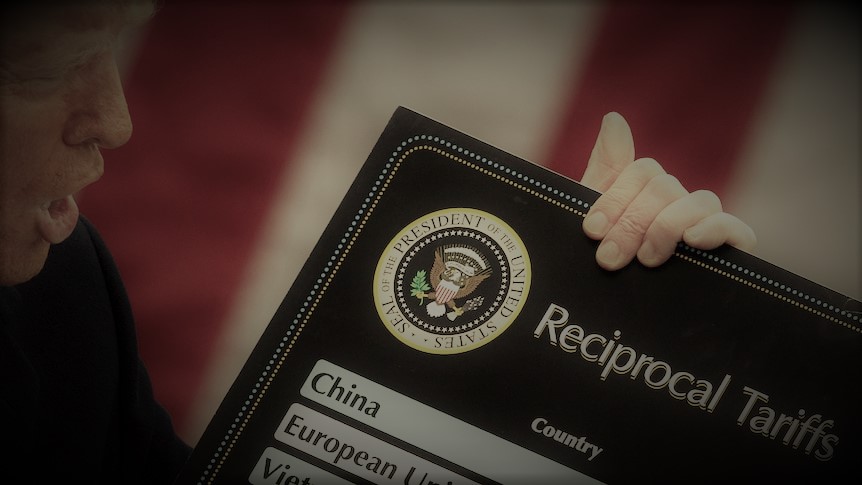
The Supreme Court in Washington dealt a severe blow to Trump’s showpiece number-one in economic policy, i.e. his tariff warfare on the rest of the world. The American president is increasingly overtaken by the bare reality that claims he has continuously made about the expected benefits of tariffs are simply not materialising. The European Union should react in a smart and calm way.
The latest phase in President Trump’s self-declared trade war on the rest of the world has, despite all the chaos and uncertainty it is once more creating for the US and the rest of the world, one silver lining to it. The decision of the Supreme Court last week to strike down the avalanche of global trade tariffs introduced last year by the Trump administration is indeed living proof that there is still life in the checks and balances system of American democracy. These checks and balances were often praised as the shining hallmark of American democracy but came under continuous attack by President Trump.
“The American president is increasingly overtaken by the bare reality that the expected benefits of tariffs are simply not materialising.”
A visibly very furious Donald Trump reacted immediately after the Supreme Court’s ruling by announcing a 10% tariff on all imports into the US, which hours later he raised to 15%. This time he invoked Section 122 of the US Trade Act as the basis for this tariff offensive. Trump claimed that the Supreme Court’s decision had actually made his possibilities to introduce trade tariffs even stronger: “Now I’ll go the way I could have gone originally which is even stronger than our original choice”. This claim is simply not true. Whether under Section 122 or Section 301 of the US Trade Act, the President will in the future always be more restricted in his options on tariffs and will have to go through Congress for new tariff initiatives to become structural. All this really presents a problem given that the November midterm elections are reducing the support for Trump’s trade war initiatives, also in his own Republican Party.
The American public is becoming increasingly aware that the cost of living increases they have to live with have a lot to do with the Trump tariff war. Hence the nose-dive in Donald Trump’s popularity. A recent CNN poll showed that almost two-thirds of Americans disapproved of Trump’s tariff policies. Among Republican-leaning voters the disapproval rate stood at 25%. The overall approval rate for Trump now stands at 39% and the disapproval rate at 56%. The fall of Trump’s approval rate extends to all issues but is most pronounced on immigration and the cost of living.
Four times wrong
Donald Trump’s narrative on trade tariffs contains at least four claims that again and again are proven to be incorrect. First there is the narrative that tariffs would be paid by the foreigners that were, in Trump’s parlance, already “ripping off” the US for decades. As every basic economics handbook will teach you, tariffs are first paid by American importers and ultimately largely passed through to the consumers in the country that imposes them, in this case the United States. Trump is losing the media battle on the “affordability” debate simply because his tariff war has pushed the cost of living up for American families and an increasing number of Americans are becoming aware of that reality.
“Trump is losing the media battle on affordability because his tariff war has pushed the cost of living up for American families.”
Secondly Trump always confidently told Americans that tariffs would make the American trade deficit melt like snow before the sun. The same basic economic handbook will teach you that this is not the way things work. The US trade deficit is due to excess domestic spending which in turn is largely due to the large government budget deficit and the modest private savings ratio. If the deficit were smaller and/or the private savings ratio larger, the trade deficit would … well … melt like snow before the sun. Tariffs can’t cure a systemic trade deficit, cutting over-expenditure always will. Last week Trump claimed on social media the “United States trade deficit has been reduced by 78% because of the tariffs”. The reality? The US trade deficit in 2025 was $901.5 billion against $903.5 billion in 2024. That is minus $2 billion or a reduction with 0.2%, a somewhat smaller reduction than the 78% claimed by the American President.
“Tariffs can’t cure a systemic trade deficit — cutting over-expenditure always will.”
Thirdly there was the claim that the revenue generated by the tariffs would contribute significantly to a reduction of the federal government budget deficit. The reality? The federal budget ended 2025 with a deficit of $1,780 billion equal to 5.8% of GDP. This means the 2025 deficit came in $41 billion lower than the 2024 deficit of $1,740 billion. That is … 2.3% lower than the 2024 deficit. But even this small reduction will most probably disappear since American companies are on the basis of the Supreme Court’s ruling already openly requesting refunds of the import tariffs they had to transfer to Washington. The amount of such refunds could easily reach $150 billion.
A fourth claim continuously voiced loudly by President Trump is that tariffs would bring more economic growth to the United States. For the fourth quarter of 2025 Trump claimed an annualized growth of 5.6%. “I’m very proud of it: 5.6%. You know, we have a GDP of 5.6 despite the shutdown”, Trump declared in a recent interview on NBC. The reality? The official data released in mid-February showed an annualized GDP growth of just 1.4% in the fourth quarter of 2025, substantially less than the 4.4% annualized growth rate of the third quarter. The lockdown for sure played a role in all this but most independent economists agree that the uncertainty created by the trade-war manoeuvres were at least as significant in the decline. The growth figure for the whole of 2025 came in at 2.2%, lower than in each year of the Biden administration.
No escalation
As for most others in the world, for the EU as well, the situation now unfolding in Washington over Trump’s tariff war requires careful thought and action. It is, first of all, not clear what exactly the legal status now is of the trade agreement reached last year between the Trump administration and the European Commission. So, we better put final ratification of this agreement on hold until there is more clarity on this legal status.
Policymakers in the EU must realize that an intensified trade war will always put us on the losing side of the equation. European authorities can of course activate the Anti-Coercion Instrument or so-called ‘trade bazooka’ but it is hard to see how we could really gain from such a move. Are we then powerless when it comes to a real confrontation? No, we’re not, but we should look for pressure points outside the realm of trade. One option we could contemplate is, as also Daniel Gros of the Institute for European Policymaking at Bocconi University has suggested, for financial regulators to assign an additional risk weight to US government bonds, making them more costly to hold and less appealing for European institutional investors. The US needs substantial amounts of foreign capital to finance its trade and budget deficits. But again: an escalation of tensions with the US is definitely not in the EU’s interest.
“An intensified trade war will always put the European Union on the losing side of the equation.”

