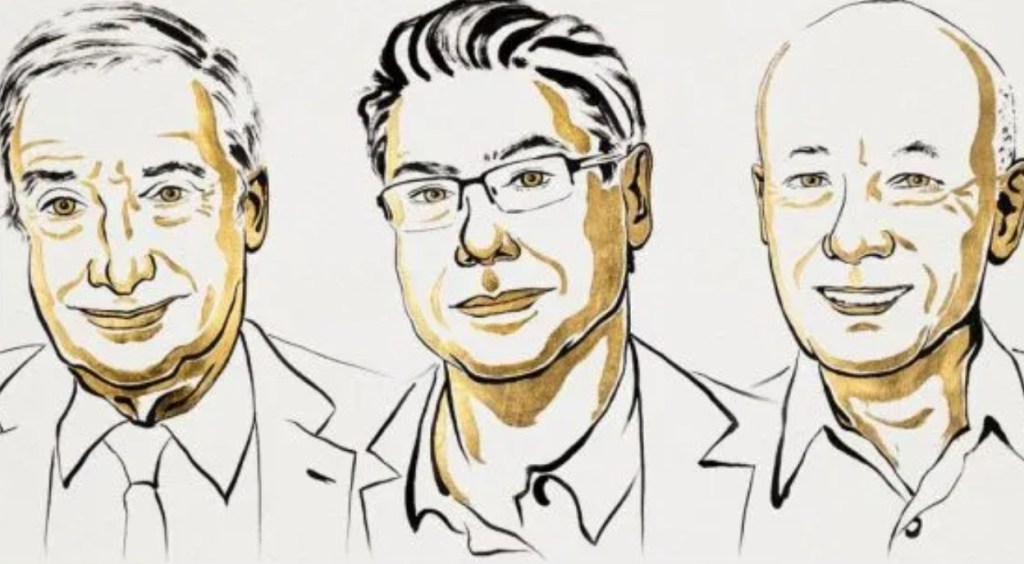
The recently awarded Nobel Prize in Economics went to three economists who focused in their research on innovation-driven growth. Given the nature of Europe’s economic weaknesses their conclusions contain crucially important lessons for the EU and its member states.
In a rather usual carve-up half of the 2025 Nobel Prize in Economics went to the Dutch-born American-Israeli economic historian Joel Mokyr and the other half to Philippe Aghion (France) and Peter Howitt (Canada). Joel Mokyr tried to find an explanation for the sudden take-off of economic growth around 1800, after human living standards had been basically stagnant for centuries. His key insight was that the growth take-off required an open society in which different types of knowledge could flourish. In Mokyr’s theory, the Enlightenment brought about a free market for ideas that massively increased the amount of knowledge and the accessibility of that knowledge to those who could make best use of it. Crucial is that the society is open to change, even of the disruptive kind, driven by the competition of new ideas.
Creative Destruction
Mokyr’s concept of disruptive change is more often referred to as creative destruction. The major contribution Philippe Aghion and Canadian economist Peter Howitt was to formalize the idea of creative destruction. In their seminal mathematical model of 1992, they explained how constant turmoil at the micro level can result in steady growth at the macro level. They argue that creative destruction is the driving factor of continuous periods of economic growth and human progress. The basic characteristic of their model is the constant entry, exit and “business-stealing” of firms driven by constant investment in R&D and innovation. When these companies are successful, meaning that they achieve a better product or production method, they steal the market and the old leader’s profits vanish. The old and obsolete is replaced by the new and more productive.
Standing on the Shoulders of Joseph Schumpeter
The three recent Nobel laureates stand on the shoulders of another economic giant, Joseph Schumpeter (1883-1950) who died long before the Swedish central bank, the Sveriges Riksbank, began awarding Nobel Prizes in Economics. Schumpeter coined the term creative destruction in his book Capitalism, Socialism and Democracy (1942). The famous quote on creative destruction goes as follows: “The opening up of new markets, foreign or domestic and the organizational development from the craft shop and factory to such concerns as U.S. Steel illustrate the same process of industrial mutation – if I may use that biological term – that incessantly revolutionizes the economic structure from within, incessantly destroying the old one, incessantly creating a new one. This process of Creative Destruction is the essential fact about capitalism.” Schumpeter characterized the growth of the last two centuries as a dynamic process, a history of revolutions, where old products, services and methods are constantly replaced by better and/or more productive new ones.
Open competition, knowledge accumulation, innovation, creative destruction: these are the basic concepts in the work of Mokyr, Aghion and Howitt and many other economists and analysts who walked in their footsteps, and those of Joseph Schumpeter). Looking at Europe’s relatively dismal performance of, say, the last decade, one cannot but be struck by the fact that these concepts, and certainly not the one of creative destruction, do not fit in well with Europe’s recent past and traditions. More specifically three steadfast characteristics of European policymaking go against the creative destruction needed to allow innovation-driven growth to flourish: our bail-out culture, the abundance of cheap money and our regulatory overzealousness.
The Bail-Out Reflex
Our bail-out culture is intimately linked to a rescue reflex that became dominant in the actions of most Western policymakers. In times of crisis, governments are consistently occupied with saving industries, financial markets, households and foreign governments from all adverse impacts. When the recovery comes, the government continues to rescue the economy from what is then all too often labelled as disappointing growth. The consequences of this bail-out or rescue culture are twofold. First, more and more capital and labor become immobilized in activities that become sub-standard in terms of productivity. Secondly, constant bail-outs lead to policy exhaustion and hence mounting difficulties of mobilizing policy action when it is really needed, as we saw with the COVID pandemic and see now with the assistance to Ukraine.
The Cheap-Money Trap
This rescue culture is aided by a cheap money culture. Central banks have continuously held interest rates low over the last few decades. Borrowing is cheap, leading to the proliferation of the amount of so-called zombie firms, being firms that are not profitable and can only remain alive through ultracheap, artificially low interest rates. These zombie firms again block large chunks of capital and labour in activities and processes that have become outdated in terms of productivity, that could be used more productively elsewhere.
Finally, the regulatory environment has become very stringent and on several occasions even counterproductive. Through regulation political authorities and their bureaucracies try to organize the economic progress. This approach disregards the ‘trial-and-error’ nature of private sector searching for new knowledge and the best technological solutions.
Draghi, Letta, and the Missing Focus
The much-discussed Draghi and Letta reports on respectively European competitiveness and the EU internal market do touch upon all the issues raised above without, however, giving them the central focus they need to have. Given the apparently dramatic effects that AI developments will tend to produce it will become even more imperative to liberate the forces of private ‘trial-and-error’ and of creative destruction. The US economy has been more open for those forces than most European economies, a major explanation for its superior economic performance.
The regulatory overzealousness, cheap money and the bail-out and rescue culture that became dominant in Western and certainly European societies over the last decades tends to obstruct creative destruction. The mentality of trying to protect what exists in the here and now blocks the necessary release of physical and financial assets and of human labor for redeployment in more productive new ventures. Instead of flowing to tomorrow’s breakthrough initiatives, capital and labor too often remain stuck in yesterday’s failures, leading to a cumulative process of diminished growth perspectives and mounting societal problems.
“ The regulatory overzealousness, cheap money and the bail-out and rescue culture that became dominant in Western and certainly European societies over the last decades tends to obstruct creative destruction”
It is the great contribution of Joel Mokyr, Philippe Aghion and Peter Howitt, standing, I repeat, on the shoulders of Joseph Schumpeter, to have laid out the iron logic of creative destruction leading to economic growth and increased welfare and wellbeing. It is high time that these insights are translated into specific policy initiatives.
 Johan Van Overtveldt