
Overloading monetary policy with other objectives besides price stability has a high risk of turning counterproductive at the end of the day. Both the Federal Reserve (Fed) and the European Central Bank (ECB) should seriously rethink what they are aiming for, besides -first and foremost- price stability.
Dutchman Jan Tinbergen (1903-1994) was in 1969, together with the Norwegian economist Ragnar Frisch (1895-1973), the very first winner of the Nobel Prize in Economics. Both were pioneers in large-scale model building and the econometrics needed for this purpose. One of the insights Jan Tinbergen is still very much recognized for is the so-called Tinbergen Rule that stipulates that effective policymaking requires that to successfully achieve n policy targets at least the same number of independent policy instruments are needed. Tinbergen explicitly warned that one of the major reasons why policies fail is because they are laden with (too) many policy objectives.
“One of the major reasons why policies fail is because they are laden with (too) many policy objectives“
More than half a century after it was first formulated, the Tinbergen Rule is still highly relevant. What does this Rule mean for the two major central banks of the world, the American Fed and the ECB? The Fed is since the Humphrey Hawkins Act of 1978 laboring under a “dual mandate” requiring the Fed to aim for “price stability” and “maximum employment”. The primary objective of the ECB’s monetary policy is to maintain prices stability, meaning “2% inflation over the medium term”. According to The Treaty on the Functioning of the European Union, the ECB shall “without prejudice to the objective of price stability” support the general policies of the EU with a view of contributing to the achievement of the Union’s objectives. “These objectives”, so the website of the ECB stipulates, “include balanced economic growth, a highly competitive social market economy aiming at full employment and social progress, and a high level of protection and improvement of the quality of the environment – without prejudice to the objective of price stability”. What a mountain to climb!
Before delving more in detail into what the Tinbergen Rule can teach us about both central banks’ policy objectives, a first thing to note is that the Fed and certainly the ECB reacted too slowly to the surge in inflation – hence, a disturbing of price stability – that was already clearly emerging in the second part of 2021 (that is, months before the Russian invasion of Ukraine). After being negative for six years, the ECB brought its policy interest rate (deposit rate) to 0% in July 2022. From there it went to 0.75% in September 2022 and then in a quick series of hikes to 4% one year later. Inflation reached 10% by the end of 2022 and subsequently came down quickly to below 3% by early 2024. The ECB lowered its deposit rate to 3.75% in June 2024 and moved then quickly to 2% one year later.
“The Fed and certainly the ECB reacted too slowly to the surge in inflation”
The Federal Reserve followed a similar pattern, up to a point. The Fed started to push up early in 2022 its policy-determining federal funds rate from 0.25% to 5.5% by August 2023. There this policy rate stayed until July 2024. Inflation in the US peaked at 9% by mid-2022 and afterwards fell to around 3% by the end of 2023. The Fed acted subsequently more cautiously than the ECB in bringing down its policy rate to 4.50% (de facto the 4.25-4.50% range) by December 18, 2024.
So, the conclusion is quite straightforward. Both the Fed and even more so the ECB decided late in the day to fight the inflation surge but in the end succeeded in bringing that inflation down again. Moreover, this successful inflation fight was accomplished by making monetary policy sufficiently restrictive without throwing the real economies into recession. While their respective upward moves of policy interest rates were quite similar, it was however in the downward phase of those policy rates that the paths of the Fed and the ECB substantially diverged.
Labor excuse
As has already exhaustively documented in the media, the Fed immediately came under fire from President Trump when he started his second term as US president at the beginning of this year. In sometimes unashamedly offensive outcries Trump lambasted Jay Powell, the Fed chairman appointed by … Trump in 2018, for being “too late” and “incompetent”. Trump explicitly requested the Fed to go to zero policy interest rates and regularly referred to the ECB’s policy rate path as the one to follow. Powell and the rate setting FOMC (Federal Open Market Committee) courageously resisted the onslaught of the president. They were right to do so: inflation remained stuck at around 3% and the American economy exhibited something close to full employment (which an unemployment rate of around 4% essentially represents).
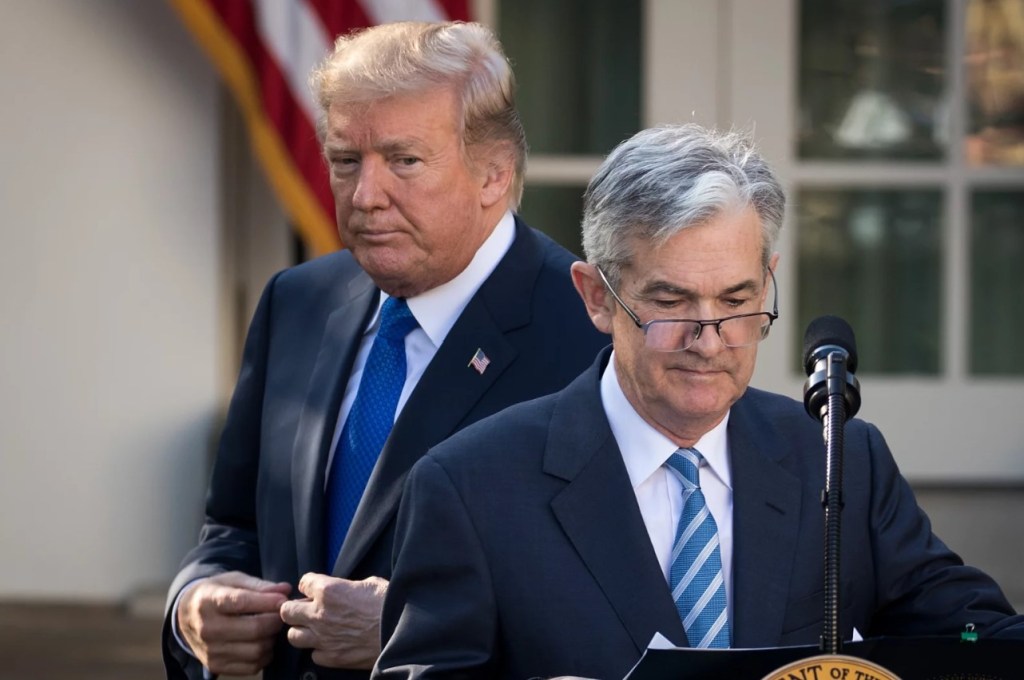
On September 17 the turn came with a decision by the Fed to lower the federal funds rate by 25 basis points to the range of 4–4.25%. The main reason for this downward move, so Powell and other Fed officials declared, was the weakness in the labor market. In August 2025 only 22 000 new jobs were created. The second part of the Fed’s dual mandate apparently took over from the first part (price stability) despite the fact that inflation was still some distance from the policy objective of 2%. In August headline inflation was still at 2.6% and core inflation (headline inflation with the volatile food and energy prices filtered out) at 2.9%.
As, among others, the renowned economist Ed Yardeni pointed out, this labor market argument was quite unconvincing. Yardeni argued that the labor market weakness in the US had everything to do with three elements: a sharp decline in immigration, voluminous retirement of baby boomers and companies going to hiring freezes due to the uncertainties created by developments in the field of Artificial Intelligence. Obviously a rate reduction by the Fed does not have any influence at all on each of these three structural factors, nor will the two further rate reductions expected before the end of the year although Jay Powell was quick to pour cold water on that expectation.
The more obvious thing to do for the Fed instead of the September rate cut would have been to stick to the policy position taken since the end of last year. Principally because of Trump’s obsession with trade tariffs, most analysts see inflation risks in the US on the upside – as is also the case in the euro area (see further) – so the relaxation of September can, if anything, only contribute to these upside risks. The argument on the labor market was, as argued, really weak. One has the impression that the labor market developments were called in as an excuse to throw a bone at President Trump. Remember the Tinbergen Rule: too many policy objectives fuel policy failures. That’s exactly what happened on September 17.
“ One has the impression that the labor market developments were called in as an excuse to throw a bone at President Trump”
Mission creep it is
The ECB acted, as indicated, much more forcefully in the downside movement of its policy rates once inflation came down significantly. After the first move down in its policy rates in June 2024 the ECB brought its deposit rate down from 4% to 2% exactly one year later. Subsequently the governing council decided twice to keep its policy rates unchanged (that is, 2% for the deposit rate, 2.15% for the main refinancing operations and 2.40% for the marginal lending facility).
This policy stance of the ECB is defendable given that in August headline inflation in the euro area came in at 2.1% and core inflation at 2.3%, both numbers more or less in line with the numbers of the previous three months. This means that real policy rates (nominal ones corrected for inflation) are basically at zero, so I agree with the conclusion also formulated by ECB executive board member Isabel Schnabel that presently the ECB “may already be mildly accommodative”. Somewhat worrying is the fact that service inflation remains stubbornly high, now at 3.1%. On top of that the same Isabel Schnabel declared in an interview with Reuters for inflation “the balance of risks being tilted to the upside for three reasons”. These three reasons are the persistent upward pressure of food prices, the fact that the rise of the euro’s exchange rate against the dollar is having a less than expected downward effect on inflation and the risk of an escalating tariff war.
Can we draw the conclusion that the violation of the Tinbergen Rule does not pose a problem for the ECB? No, not at all. The problem lies most of all in the field of environmental and climate change tasks that the ECB is said to have taken seriously. These concerns have apparently not (yet) brought the ECB in territory where the maintenance of price stability is made more cumbersome. The problem is that the ECB, most of all through its executive board member Frank Elderson, pursues a highly questionable role that risks undermining its credibility and the trust it needs to radiate to the markets and the public.
Frank Elderson is pushing fervently the climate change agenda inside the ECB. Politico revealed last year that Elderson does not hesitate to handle things in a distinctly authoritarian way. He told an internal meeting that “I don’t want these people anymore” referring to people who don’t buy fully into the ECB’s green objectives. He added: “Why would we want to hire people who we have to reprogram?” A free and open discussion on climate and nature issues is apparently no longer possible within the ECB and scientific evidence is used selectively. In recent speeches Frank Elderson emphasizes continually what he describes as the twin climate and nature crises. However, referring to the devastating fires in Los Angeles he forgets to mention the important role played in these disasters by human failures and criminal behavior. When discussing the deadly floods in Valencia there is no mention of the manifest failures of the Spanish authorities to take care of the urgently recommended infrastructure works. It was also argued that Slovenia saw … 16% of its GDP being washed away by extremely heavy rains. This huge number is hard, if not outright impossible, to reconcile with the overall macroeconomic scoreboard of Slovenia. There is probably more than a grain of truth in the argument made by some insiders that Slovenia cleverly took advantage of the situation to obtain from the EU resources to replace large chunks of its outdated infrastructure.
“A free and open discussion on climate and nature issues is apparently no longer possible within the ECB and scientific evidence is used selectively”
So, with the mission creep in the direction of climate and nature policies the ECB is clearly in violation of the Tinbergen Rule and risks to end up with policy failures in its basic task of safeguarding price stability. Indeed, the whole climate change discussion is highly sensitive and becoming even more so. It is not a question of, as the Elderson-ites like to do, pointing to those who challenge his approach as extremists or ignorant ones. It is all about facing up to scientific evidence and the complicated choices societies have to make since all these choices involve costs and benefits.
The ultimate risk for the ECB by engaging itself in a very outspoken way in this climate discussion is that the political world will start to react to it.
If you step into highly sensitive political discussion areas, don’t be surprised if the political world starts entering your domain.
Such moves will endanger the ECB’s independence which is very much needed if the ECB wants to credibly stand as the defender of price stability. Without price stability you cannot have a well-functioning economy. So, please, stop the mission creep.
 Johan Van Overtveldt