Vladimir Putin brought the reality of war back in our daily lives. As a rude awakening from decades of living in peace, this could really count. There is however a second rude awakening for us lurching just around the corner. The huge challenges we face today will necessitate stepping away from the bailout culture and rescue reflexes dominating our societies to make room for a restoration of the creative destruction imperative.
On February 24, 2022 most Western European citizens couldn’t believe their eyes and ears. On that fateful day Vladimir Putin launched his “special military operation” against Ukraine, a euphemism for the total war with which the Russian president intended to annihilate the Ukrainian nation and its budding democracy. For Putin the only raison d’être of the Ukrainian entity is being an integral and subjugated part of the Great Russian Empire he desperately wants to re-create. More than three years into that vicious war there is no intention detectable on Putin’s side to end the horror.
Never again?
The astonishment and shock of most Western European citizens had everything to do with the fact that the Russian invasion had squarely brought war back into to the heart of the European continent. Twice during the first part of the 20th century that European continent had been devastated by extreme war violence. “Never again” was the slogan behind which the post Second World War political generation started the process of European integration. After the unspeakable suffering brought about by those two world wars peace should be guaranteed at any price. Public support for the European project was overwhelming.
Except for the civil war in former Yugoslavia the European peace forever dream seemed to be coming true during the first seven decades after 1945. But then Vladimir Putin arrived on the scene. Western policymakers as well as the broader public basically ignored the signals the Russian president had been flagging with, amongst others, his military intervention in Georgia in 2008 and the annexation of the Crimea region of Ukraine in 2014. In the days, weeks, months and years following February 24, 2022. We Europeans had to acknowledge the unthinkable: war had come back to Europe. Vladimir Putin and his clique regularly suggested, and sometimes even said very explicitly, that, if necessary, they would not hesitate to broaden the Ukrainian conflict and suck in other countries.
“Western policymakers as well as the broader public basically ignored the signals the Russian president had been flagging“
Putin’s War Logic
A rude awakening had descended upon us, Western Europeans: in order to prevent further war escalations we had better start preparing seriously for war. This horrific reality needs to sink in thoroughly because, as far as one can see now, Putin will not walk away from the war option. The Ukraine conflict has allowed him to consolidate his domestic power, tighten his grip on Russian society and hugely augment centralized control in ways he could only dream of before the war started. His regime’s chances of survival are now intimately linked to relentless continuation of war efforts, whether in Ukraine or elsewhere in Europe. It can even be argued that the war in Ukraine has for Vladimir Putin over time turned from a project mainly about territorial conquest into one focusing more on internal power consolidation. Winning the Ukraine war has in this logic become less important than keeping it going. We have to face what Alexandra Prokopenko has defined as “Putin’s insatiable appetite for war”.
Axis of resistance
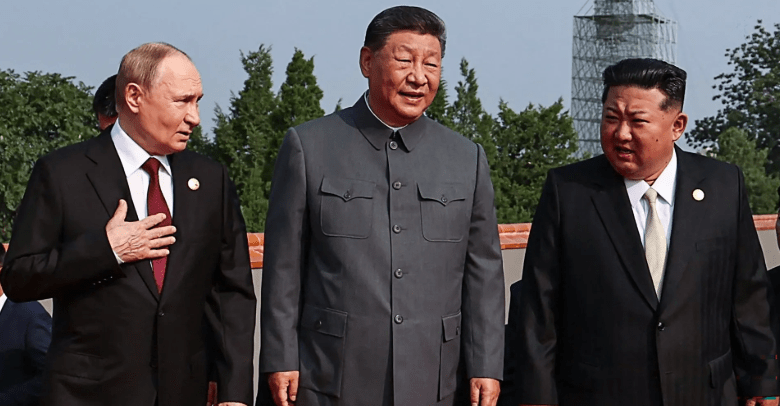
Moreover, on top of the internal Russian political logic to keep the war in Europe going, there is also the support the Putin regime is presently enjoying from partners like Iran, North Korea and China, the so-called “axis of resistance”. The theocratic regime of Tehran is, despite the military humiliation it is suffering through Israeli and American actions, continuously supplying Russia with Shahed drones. North Korea is not only providing soldiers for the meat grinder the Ukraine war has become, but is also sending in ever larger amounts of ammunition, howitzers and ballistic missiles. There is evidence that Russia is stockpiling large parts of its own ammunition production to be ready in case of a sudden escalation or broadening of the war activities. Russia is now spending at least 8% of its GDP on defense. Last but not least there is China. Despite strong denials from Beijing, China has become the key supplier of Russia’s defense industry. Xi Jinping’s China tries to play the serious kid on the block looking for peace and conciliation but in reality, it applauds and supports as secretly as possible Putin’s war on Western democracies and values.
Only the knowledge that, despite all the support of his partners, there’s no way he can win a further war escalation in Europe will withhold Putin from going that way, not least because, as argued, such a war escalation allows him an all-encompassing grip on power and control inside Russia. It is an understatement to say that we were unprepared for the brutal logic of the Ukraine war and the vicious propaganda launched by Putin’s Russia. Russian trolls, so a thorough analysis by researchers at the Rand Corporation revealed, are indeed incessantly producing “a firehose of falsehood … an unremitting, high-intensity stream of lies, partial truths, and complete fictions”.
Feeling safe through NATO under the American conventional and nuclear umbrella, Western European countries reduced over the last decades their military efforts, as can be seen in figure 1 below, and spending to such levels that their military preparedness has become a joke. The persistent crawl back of spending for defense purposes was a major contributor to the expansion of Western European welfare states. American presidents at least since Ronald Reagan complained about the lack of sufficient European contribution to the collective Western military and defense effort. It took the brutality of present American president Donald Trump to make this lack of European contribution into a casus belli. There are many reasons to disagree, and disagree very strongly, with many things Trump is doing but his attack on Europe’s lack of responsibility in military and safety matters is entirely correct.
“The persistent crawl back of spending for defense purposes was a major contributor to the expansion of Western European welfare states“

that were member of the European Union in 1995. Source: SIPRI, AMECO.
We have nothing or nobody to blame than ourselves for the present defense mess we’re facing. With on the one hand the clear threat of Putinesque expansionism beyond Ukraine, silently condoned, even supported by China, Russia’s major supporter, and on the other hand a lot of uncertainty about American engagement in the European theatre, we have to produce a monumental catch-up effort. And we must do it as fast as possible. The immense effort before us does not merely impose a drastic increase in defense spending – for many Western European countries a structural increase of defense spending by 2 percentage points of GDP – it also necessitates the built-up of significant modern industrial capacity to deliver what is needed, not for the last war but for the war of the future.
“We have nothing or nobody to blame than ourselves for the present defense mess we’re facing“
Tanks, artillery, fighter jets, submarines and warships will remain important but less than they were in past military conflicts. The Ukraine war is the first drone war showing that for future war capabilities technological innovation, artificial intelligence and unmanned weapons systems will be crucial. Drones have enabled the heavily out-manned and out-gunned Ukraine forces to hit their Russian adversaries hard. Small-scale Ukrainian entrepreneurial efforts to enhance the country’s drone capacity have been truly impressive, not least in terms of the cost price of drones. Ukraine’s Unmanned Systems Forces constantly optimize the communication between frontline events and drone production and development.
For this capacity build-up to be efficient and structural European authorities will have to safeguard and even strengthen the EU internal market. Only then will the much-needed entrepreneurial drive, start-up activity and economies of scale in military industrial capacity become reality. It would be a huge mistake to focus the new defense efforts on the larger concerns already active in the defense branch. Letting innovative market forces have their go at the defense world of tomorrow might allow Europe not only to catch up fast with Russia, China and even the United States, it might even bring us in the lead in important areas.
“For this capacity build-up to be efficient and structural European authorities will have to safeguard and even strengthen the EU internal market”
Himalaya
The massive additional defense effort with which most West European countries see themselves confronted brings us seamlessly to the second rude awakening, one that has not yet reached a majority of policymakers and citizens. Many of our policymakers and citizens have not yet felt it but there is no doubt whatsoever in my mind that this second rude awakening is coming. Whether it arrives in time and whether we deal with this shock appropriately will determine our future as a Western democratic society.
The huge Putin- and Trump-induced defense spending that West European countries have to deliver has become part of the set of Himalaya-like challenges we’re facing halfway into the 2020 decade. A limited list of these challenges would include:
- The relentless pressure from mounting geopolitical volatility and uncertainty increasing the likelihood of limited local conflicts, like in the Middle East for example, to escalate into wilder storms engulfing the major world powers;
- The rising attractiveness for the broader public of authoritarian political models and its leaders like Donald Trump, Xi Jinping, Vladimir Putin and Recep Tayyip Erdogan, not to forget European leaders like Hungary’s Victor Orbán and Slovakia’s Robert Fico and the rise of extremist right- and left-wing political groups in almost all European countries;
- The demographic turnaround characterized by an aging of society and even outright de-population creates extreme public finance pressures and mounting social tensions;
- The need for European countries to restore international competitiveness after climate change-induced policies produced substantial competitive disadvantages for European companies and investors;
- The European integration project is stuck somewhere between on the one hand a simple partially unified economic zone and on the other hand full political integration, producing all too often gridlock, ad hoc decision making and the constant threat of blackmail;
- The impact of climate change-related calamities like more extreme weather conditions and natural disasters need to be met in more efficient and competitiveness enhancing ways;
- Budget deficits and debt accumulation are becoming increasingly precarious, certainly if the so-called hidden debt, mostly in the field of pension liabilities, is taken into account. Given the already prohibitive levels of the overall taxation burden in most European countries, structural solutions to the public finance quagmire ought to be sought on the expenditure side of the governments’ balance sheets;
- The uncertainties surrounding new technological developments like Artificial Intelligence and genetic modifications are huge. They are not only of an economic and financial nature but also of a deeply ethical one;
- Inflation remains a “lurking killer”. As Lenin recognized, there’s no surer way to destabilize a market economy than letting the evil forces of inflation loose. A heavy responsibility rests on the shoulders of monetary authorities;
- The next major financial crisis never seems far away. Among the flashing alarm lights of today should certainly be counted, first, the crypto craze (that moreover offers the international criminal world excellent hide and recycle opportunities) and the huge increase in private credit take-up involving also traditional banking and insurance groups.
Restoring creative destruction
As I documented in my 2024 book The Icarus Curse European policymakers – and to some extent also other Western democratic elites – have to face this Himalaya of challenges in a state of quasi policy exhaustion. Decades of flagrant political abuse of the heritage of John Maynard Keynes’ succinct analysis of the Great Depression of the 1930s dynamics has produced a situation where further intensified use of budgetary and/or monetary stimulus is no longer possible without running into major risks of serial debt defaults, monetary chaos, market hysteria and the inevitably accompanying social and political debasement of our democratic societies. Figure 2 below shows the accumulating government debt. John Maynard Keynes (1883-1946) would surely turn around in his grave if he could see the havoc and foolishness perpetrated in his name by the actual and past generations of leading politicians and central bankers.
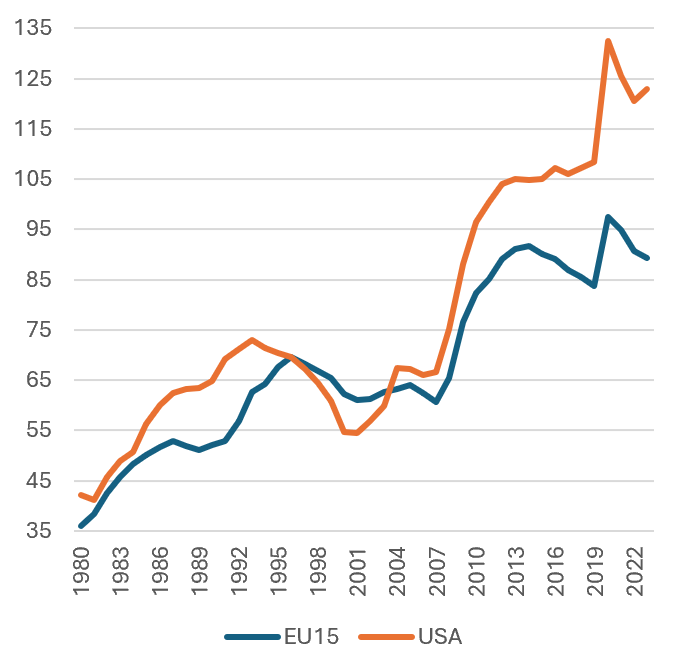
15 countries that were member of the European Union in 1995. Source: IMF global debt database.
The only way out of this conundrum is economic growth, which has been lagging lately, as can be seen in figure 3 below. Not the economic growth brought about by budgetary and monetary stimulus, for which, as just stated, there is in any case hardly any room left (with a country such as Germany being proverbial exception to the general principle). The economic growth we urgently need has to come from the release of market forces in a truly competitive environment. It is too easily forgotten these days that it was basically these forces that brought about the never before in human history experienced increase in human welfare and well-being that was effectively realized during, say, the last two centuries. For those no longer convinced of this reality, read, for example, Gregory Clark‘s Farewell to Alms (2007), or Hans Rosling’s Factfulness (2018), or Philip Coggan’s More (2020). Or any of the manifold other books and essays making basically the same argument on the basis of mountains of hard evidence.
“The only way out of this conundrum is economic growth”
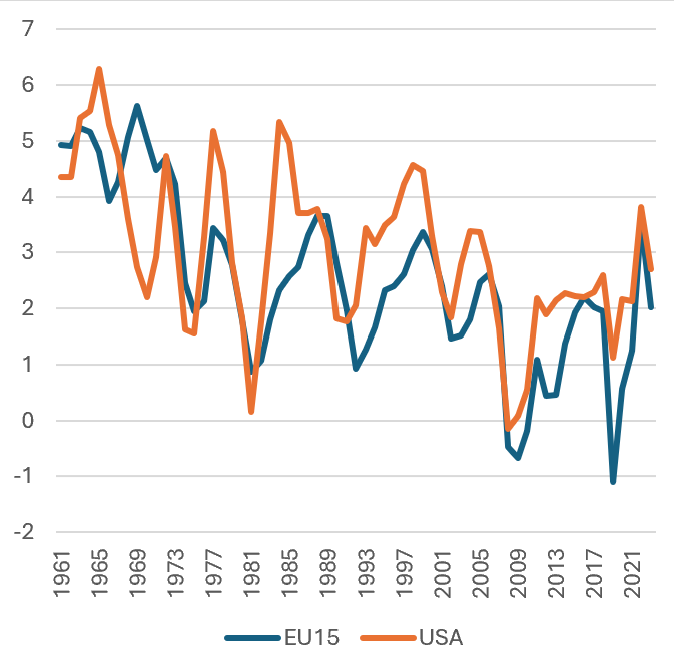
15 countries that were member of the European Union in 1995, where before 1991,
the figures of Western Germany are used for Germany. Source: AMECO, European Commission.
Addiction to bailouts and rescues
For economic growth to get revitalized a rude awakening has to take place. We have to walk away from what has become deeply ingrained, i.e. our bailout culture and our regulatory overzealousness that all too often creates senseless growth inhibitors. Our bail-out culture is intimately linked to what Ruchir Sharma, chair of the Rockefeller Foundation, defined as the “rescue reflex” that became dominant in the actions of most Western policymakers. In his most insightful analysis, fully developed in his book What Went Wrong With Capitalism (2024), Sharma describes how the compulsive inclination of politicians to intervene and spend money has been supercharged by the central bank policies of, say, the last three decades.
In an op-ed piece for the Financial Times Sharma summarized it all succinctly by arguing that “more than low interest rates, the easy money era was shaped by an increasingly automatic reflex to rescue – to rescue the economy from disappointing growth even during recoveries, to rescue not only banks and other companies but also households, industries, financial markets and foreign governments in times of crisis … The hazards are not just moral or speculative – they are practical and present. The rescues have led to a massive misallocation of capital and a surge in the number of zombie firms (those companies only able to survive on the wings of easy money policies) which contribute mightily to weakening business dynamism and productivity … Government intervention eases the pain of crises but over time lowers productivity, economic growth and living standards”. On top of Sharma’s list of “rescue reflex” consequences there is the harsh reality of it leading to policy exhaustion and hence the mounting difficulties of mobilizing policy action when it is really needed.
Addiction to bail-outs and rescues – including the subsidy mania – have increasingly poured cold water over what the legendary Austrian-American economist Joseph Schumpeter (1883-1950) pointed out to be the defining characteristic of market economies, i.e. the relentless process of “creative destruction”. Competitive forces produce innovations of all sorts that continuously challenge the existing structures and procedures. New, better and/or cheaper products, services and processes push existing entities out of business, or at least force them to adjust substantially. Hence “creative destruction” since it involves destruction of what exists to be replaced by something new, something more creative. This process is key in promoting productivity increases, in its turn the main driver of economic growth. The much discussed Draghi and Letta reports on respectively European competitiveness and the EU internal market do touch on all this without, however, giving it the central focus it needs to have. Given the apparently dramatic effects that AI developments will tend to produce it will become even more imperative to liberate the forces of creative destruction. The US economy has been more open for those forces than most European economies. Large incumbent companies tend to be an obstacle to creative destruction, on both sides of the Atlantic (and in the rest of the world too).
The regulatory overzealousness and bail-out and rescue culture that became dominant in Western and certainly European societies over the last decades tends to obstruct creative destruction. The mentality of trying to protect what exists in the here and now blocks the necessary release of physical and financial assets and of human labor for redeployment in more productive new venues. Instead of flowing to tomorrow’s breakthrough initiatives, capital and labor too often remain stuck in yesterday’s failures. Especially the involvement of labor in this often painful adjustment process is from a society point of view a most sensitive issue. Creative destruction often demands serious sacrifices at the level of individuals and groups strongly hit by the forces of change in a market economy. We should not leave those in such precarious situation “hanging in the wind” but do everything possible to help them adapt to the new realities and to keep them in the work force.
X X X
Creating the policies needed to respond effectively and efficiently to the two rude awakenings described should be the all-dominating focus of Western and certainly European policymakers. The task is huge, if not truly Herculean, not least because our societal environment does not really seem ready for such a shock. Most people do sense that “something has to be done” and that going further in the mode of the recent past is no option at all. But that does not mean that even those people who understand the dramatic changes in the world around us are ready for the policies needed, and the sacrifices they imply, to deal with that new reality. Not only politicians are experts in kicking the can down the road.
The monumental task before the present generation of politicians and other public policymakers, if they want to take real responsibility for present and future generations, is double.
First, they have to convince the citizenry of the major policy changes needed to protect our welfare and our democracy. Second, they will have to show a lot of courage and perseverance by not only introducing the needed policy changes but also standing firm by these policies over a prolonged period of time. I don’t see convincing signs around me of such a generation of politicians and bureaucrats taking the initiative, a troubling perspective for which I cannot but plead guilty too. But as the Belgian sociologist Mark Elchardus notes, “even the impossible must be attempted at some point”.
 Johan Van Overtveldt