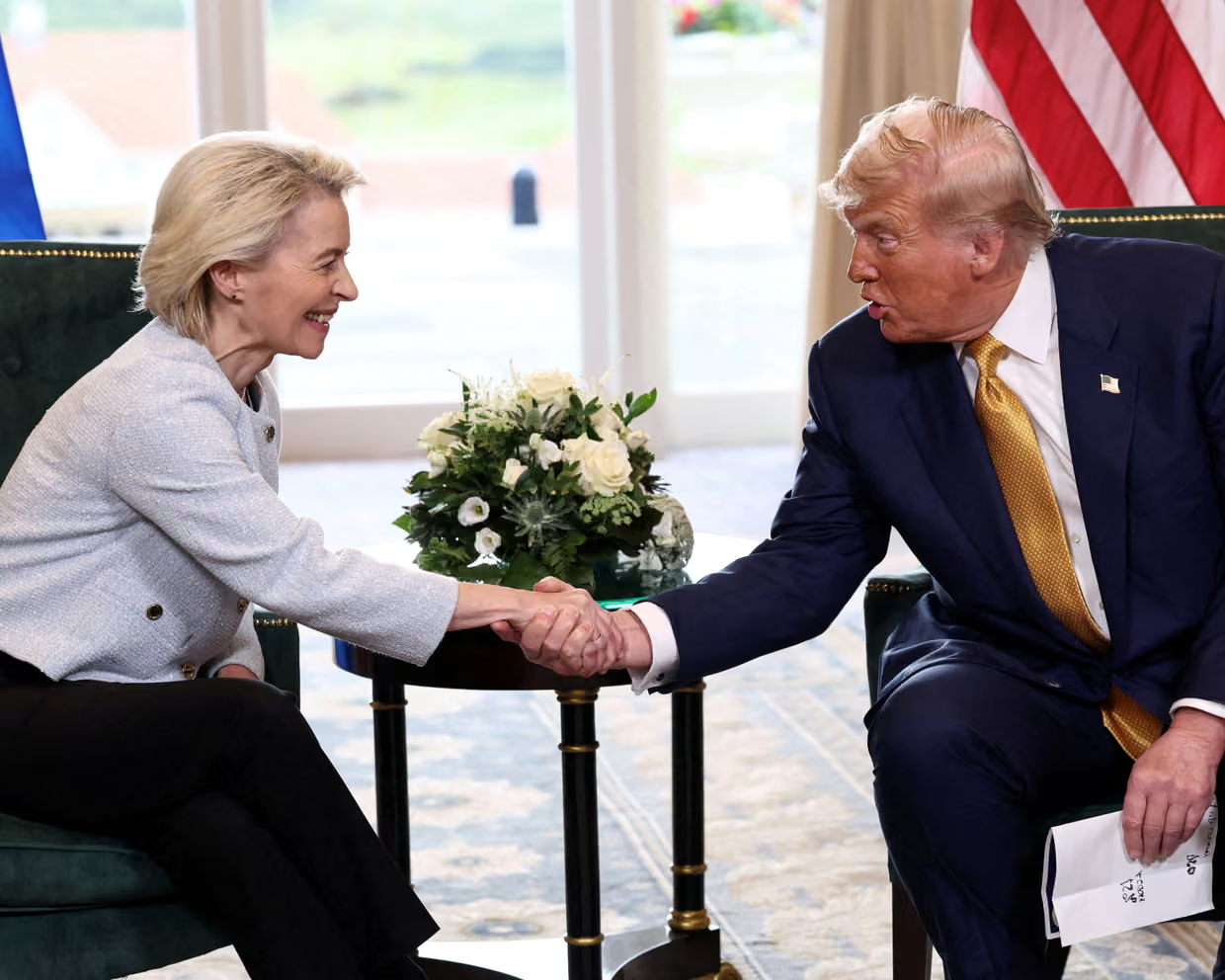
The recent US-EU trade deal is not as bad as one could have feared it to be (good). However, the already poor growth prospects for the European economy will be further diminished by the Donald-Ursula-deal (bad). Moreover, some really nasty consequences could flow from the energy and weapons buying to which the EU has engaged (ugly). So the European Commission under president von der Leyen is not really rehabilitating itself after the poor performance with its propositions for the 2028-2035 European budget.
The deal agreed between European Commission president Ursula von der Leyen and American President Donald Trump on Sunday July 27 at President Trump’s Turnberry golf course in Scotland is bad news for the European economy. Seventy percent of European exports to the US, representing close to 800 billion euro, will be hit with a 15 per cent tariff while American exports to the EU remain tariff-wise untouched. Some products have been excluded from the 15 per cent tariff (aircraft and component parts, some chemicals, agricultural products, natural resources and critical raw materials) and the new tariff replaces the 27.5 per cent tariff applied to European car export to the US. What will happen to European exports of steel and aluminium, now under a 50 per cent tariff, remains unclear.
Any trade deal imposing tariffs is always a bad deal unless tariffs are imposed to come to a level playing field between the parties involved. When China, or, for that matter, any other country, rigorously protects its own market, develops behind that wall a whole industry (e.g. electric vehicles) that then benefits from important economies of scale delivering a huge competitive advantage vis-à-vis the rest of the world, the conclusion must be that the level playing field is no longer there. Imposition of compensating tariffs is then sound policy.
“ Any trade deal imposing tariffs is always a bad deal unless tariffs are imposed to come to a level playing field between the parties involved.”
Between the US and the EU there is basically no such thing as a major policy-induced disturbance of the level playing field and hence no reason whatsoever to start a tariff battle between the two entities. The sad truth is that president Trump wants to impose tariffs because that is what he believes in and promised during his MAGA electoral campaign last year. The reality of such a tariff war being in the end disadvantageous for all economies concerned, also the American one, is a reality that is totally alien to the American president.
Weak hand to play with
Given, first, the attitude and convictions of Trump just described, second, the complete disaster an all-out trade would provoke certainly for the EU, and, third, the message of some EU member states that we Europeans should not forget that defense-wise we’re for the coming years still heavily depended on the US (and hence should not antagonize Trump too much), it has to be recognized that all in all Ursula von der Leyen, EU trade commissioner Maroš Šefčovič and their advisors did not do so bad as some of the reactions out of certain EU capitals implied. They had a weak hand to play with from the beginning and, as the saying goes, the best pilots are always on shore.
Trojan Horse(s)
The other components of the “Turnberry deal” are, however, potentially more threatening to Europe’s future than the trade part. I refer more specifically to the engagement von der Leyen has committed to with respect to energy and weapons buying by the EU in the US. The first thing to note is that there does not seem to be a legal base for such commitments by the European Commission. But even more important than the legality question, is the prospect of these buying engagements to become over time real Trojan Horses undermining Europe’s present and future industrial capacity and deepening the continent’s strategic dependence on the United States.
Exactly what and for how much weaponry the EU will have to buy in the US is apparently not yet determined in detail. Some of this buying will be inevitable since Europe is still very dependent on American military stuff. Especially with respect to for example surveillance systems, fighter jets, artillery and missile systems we’ll be dependent on American supplies for a long time to come. The combination of Russia’s threat to European security with the Trump administration being much more ambivalent about American support for Europe has created a strong drive in Europe to develop its own military industrial capacity. Is the “buy American” part of the Turnberry deal a Trojan Horse, meaning a Trump ploy to at least delay if not structurally handicap the European drive to come to more strategic military self-sufficiency? This whole process will have to be carefully managed and scrutinized to avoid a really bad outcome for Europe’s security.
“The other components of the “Turnberry deal” are, however, potentially more threatening to Europe’s future than the trade part.”
With respect to the energy buying there is some more information already available. The EU will have to buy up to 250 billion dollar per year worth of American energy products, including gas, oil and nuclear fuel. Last year the EU bought about 75 billion euro of such energy products from the US out of a total energy import by the EU worth 375 billion euro. Going from importing 75 billion euro from the US to importing 250 billion dollar from the US is according to almost all energy specialists just impossible at such short notice (even taking into account a substantial further weakening of the US dollar exchange rate).
The most worrying part of the energy part of the Turnberry deal is however the price aspect. At what prices will the EU buy these American energy products? European industries are already for many years now confronted with American competitors that pay for their energy supplies only a fraction of what industrial companies in the EU have to pay. For example, American industrial gas prices are only a quarter, and sometimes even less than that, of the level of European industrial gas prices. If this energy cost disadvantage is further aggravated by a bad deal between the EU and the US, we will accelerate the already alarming decline of the industrial base in Europe. Again, the possibility of a Trojan Horse being brought into the European continent is unfortunately all too real.
In conclusion it is fair to say that a “good, bad, ugly” deal was negotiated by the European Commission led by president Ursula von der Leyen. So the Commission and her president did not rehabilitate themselves after the poor performance a few weeks earlier with their initial proposals for the 2028-2035 European budget, the so-called MFF (Multiannual Financial Framework). What went wrong there will be among the major intra-European discussions after the summer break. As will, of course, also be the Turnberry deal.

