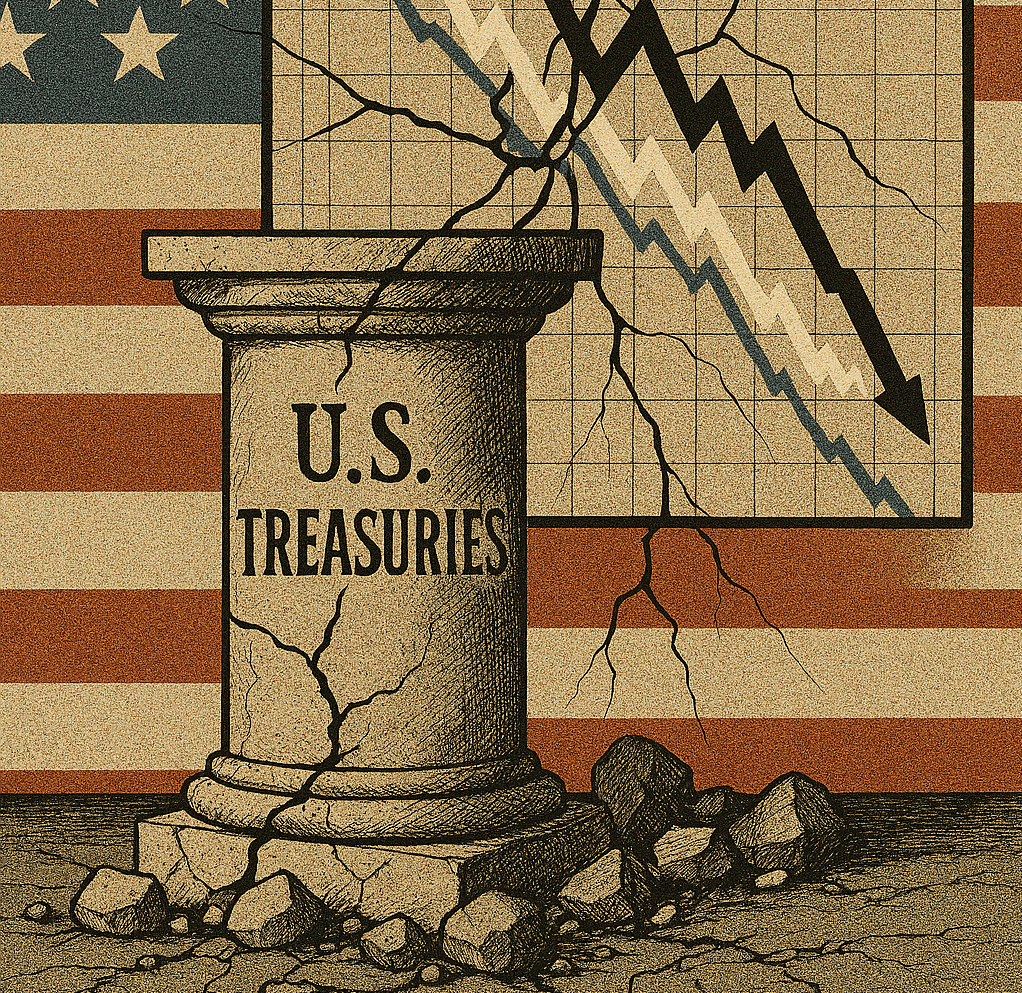
It happened between April 2 and April 7 and was barely noticed by the general public. In financial markets, however, it registered as an earthquake measuring something like 10 on the Richter scale. Are the days of the US Treasuries market as the bedrock and unshakeable pillar of the international financial system really over?
It was a most remarkable sight. During the heyday of the 2008 Great Financial Crisis, panic and a flight from almost every conceivable asset were the order of the day. International investors fled like a stampeding herd into US Treasuries, the safe haven amidst all the turmoil of those frightful weeks and months. Never mind that the US markets — with the subprime mortgage bubble and other speculative excesses — were the epicenter of the greatest financial crisis since the Second World War. The safe-haven status of the massive US Treasury market was never in doubt, even as practically every other segment of the international financial markets was tanking.
US Treasuries are Treasury bills, notes, bonds, and TIPS (Treasury Inflation-Protected Securities) issued by the United States Department of the Treasury to finance the federal government’s debt. In recent years, that debt has increased considerably due to persistently large budget deficits. Indeed, despite healthy economic growth, US government spending has failed to normalize in the post-Covid era. Last year, the federal budget deficit stood at 6% of GDP. The total US Treasury market amounts to about $35 trillion, of which roughly one-third is held by international investors. The largest foreign holders of US Treasuries are Japan, China, and the UK.
“Despite healthy economic growth, US government spending has failed to normalize in the post-Covid era.”
Backbone
The global public bond market amounted to $102 trillion at the end of 2024. US Treasuries account not only for more than a third of this ocean of debt paper, but also form the backbone of global financial markets — which, in turn, play a crucial role in keeping our globalized, albeit increasingly fragmented, economy running and in ensuring the continuous financing of the massive amount of global debt (estimated at over $300 trillion by the end of 2024).
US Treasuries are widely regarded as the benchmark credit against which all other debt securities are compared and priced. Quite simply, this means that interest rates on US Treasuries — from very short-term bills to 30-year bonds and beyond — have a direct impact on the interest rates that consumers, businesses, and governments around the world pay when they borrow money.
For decades, US Treasuries have been globally recognized as deep, liquid, and safe assets — a status closely tied to the creditworthiness of the United States, its role as the world’s leading economy, and the strength of the rule of law upheld by the American judicial system. The second Trump presidency, one might conclude, is not exactly reinforcing these high-quality attributes of the United States’ standing and reputation (see below).
And then everything changed
In the immediate aftermath of Trump’s ‘Liberation Day’ (April 2) announcement of a massive trade tariff offensive against the rest of the world, investors once again fled to the US Treasury market in search of safety amid all the turmoil and uncertainty. As a result, long-term dollar interest rates fell significantly. For example, ten-year US Treasury yields dropped by 30 basis points in a single day.
This was certainly good news for US Secretary of the Treasury Scott Bessent, who had repeatedly stated that he was closely monitoring the 10-year yield on American debt. His concern is quite understandable, given the persistently large US budget deficits — deficits that are expected to increase further as a consequence of the Trump administration’s policies.
The flight to US Treasuries went, as is most often the case, hand in hand with a flight out of equities and other assets considered riskier — especially against the backdrop of Trump’s actions, which increased the likelihood of both inflation and recession. The Financial Times concluded that this sequence of events once again underscored “the continued appeal of Treasuries as a safe harbor for investors.”
Despite the many uncertainties, the spectacular volatility, and the often quite counterproductive and contradictory nature of Trump’s policies, the factors underpinning the status of US Treasuries appeared to remain intact — or so it seemed.
The tables began to turn shortly after the Liberation Day announcements. Amid all the turmoil generated by Trump’s tariff offensive and the immediate retaliatory measures from China, something truly spectacular happened. Stock markets tanked — and at the same time, investors also fled from US Treasuries, pushing long-term American interest rates sharply higher.
Investors were not only shocked by the magnitude of Trump’s tariff assault, but also began to realize that this president is indeed capable of previously unthinkable measures. Suddenly, some of the truly unorthodox ideas floated by Donald Trump and members of his inner circle began to seem more realistic.
One such idea — forcing foreign holders of US Treasuries to swap them for lower-yielding perpetual bonds — sent shivers down the spines of many, especially international investors.
Regime shift
Surprise and consternation reigned at the sight of this highly unusual simultaneous sell-off in both equity and US Treasury markets. Some analysts and investors began murmuring about a ‘regime shift,’ as US Treasuries no longer appeared to be regarded as the fixed-income safe haven.
Former US Treasury Secretary Larry Summers posted on X that the United States was now ‘being treated by global markets like a problematic emerging market.’ The fact that an additional risk premium is now weighing on US debt is undeniable — and represents a major new factor for investors worldwide.
It is still not entirely clear what exactly triggered this regime shift — apart from the widespread unease with Trump’s policies. Hedge funds, desperate to reduce their highly leveraged positions, appear to have played an important role. Another striking feature of those days was the flight to gold, whose price surged spectacularly.
What is beyond any doubt, however, is that what some may have somewhat prematurely described as a ‘regime shift’ may indeed soon become exactly that. No one knows what comes next in such a scenario — but it’s unlikely to be the kind of good news the global economy so badly needs right now. Uncertainty, lack of trust, and consequently unpredictable moves by key private and public actors are likely to increasingly dominate the scene.
“What some may have somewhat prematurely described as a ‘regime shift’ may indeed soon become exactly that.”
For the United States to undo the damage of recent weeks and restore the US Treasuries market as the bedrock of the international financial system — which is very much in America’s own interest — a few key policy changes are needed. Chief among them should be more disciplined government spending and more predictable trade, fiscal, and regulatory policies.
The chaotic walk-back by Donald Trump on the start date of his massive import tariffs — clearly triggered by the US Treasuries market sell-off — might suggest a shift in attitude, but no one should get their hopes up. In fact, subsequent behavior indicates that the current president and his inner circle seem uninterested in the kind of policymaking that signals seriousness, responsibility, and predictability. The recent flip-flopping on electronic tariffs was yet another case in point.
The world — including the United States — will pay a heavy price for all of this.
 Johan Van Overtveldt