The effort needed to elevate Europe’s defense capabilities and capacity appropriately given Russia’s increasing belligerence and the mounting transatlantic stress is just mind-boggling. However, not all EU defense news is gloomy. The focus for the short term should be on sustaining and reinforcing the Ukrainian armed forces, not least by developing a real alternative to Elon Musk’s Starlink.
Rude awakening
The day after the 9/11 terrorist attacks by Al Qaeda on American soil, George Will, one of America’s leading political commentators in those days, wrote in The Washington Post an opinion piece entitled “The End of Our Holiday from History”. Will described the 1990s as the decade during which the United States took a “holiday from history”. This “holiday” meant living under the illusion that after the implosion of the Soviet Union and the end of the Cold War American citizens could feel safe and untouchable from the rest of the world. 9/11 caused a rude awakening.
Europe today is amid a similar rude awakening. Whereas the Americans took a “holiday from history” for a decade, we in Europe took a three quarter of a century vacation. Since the end of the 1940s we lived our lives on the European continent protected by the military (and nuclear) umbrella of the United States. We largely left our defense to them and took their umbrella for granted. Warnings from predecessors of the present American president about the sustainability of this arrangement went unheard. It is only very recently with the re-arrival of Donald Trump in the White House coinciding with Russia’s ongoing aggression in Ukraine and beyond that it finally dawned on the European elite that the days of easy and cheap sheltering under the American umbrella are over.
“We, in Europe, took a three quarter of a century vacation.”
The effort needed for Europe to be able to take up full responsibility for its defense is mind-boggling. A recent study by think thank Bruegel and the Kiel Institute for the World Economy concludes that an annual extra defense spending effort to the tune of at least 250 billion euro is needed for the EU.
The Financial Times comes up with a number that is even almost 100 billion euro higher. The authors of the Bruegel and Kiel study suggest that their 250 billion euro bill could be split equally between EU and national funding. The European Commission’s proposal of a 150 billion euro Defense Fund fits perfectly into this scheme.
Given the state of the public finances in most member states of the EU and the painfully complicated discussion within the European Council and the European Parliament on how to fund the European Defense Fund, the task of coughing up an extra 250 billion euro annually is nothing but gigantic. Notable too is that these numbers also prove rather straightforwardly that the remark that European countries were able to build a most generous welfare state on the back of the American military protection, rings at least partly true. Welfare spending in Europe is currently, and already for a very long time, on average almost double the welfare spending in the United States.
“The task of coughing up an extra 250 billion euro annually is nothing but gigantic.”
Some momentum
Given the huge budgetary challenges before us and our obvious lack of comprehensive military hard- and software, the discussion on our defense preparedness risks becoming enveloped in only gloom and doom. That shouldn’t be the case. The Economist recently examined Europe’s military production and came up with a more nuanced story. After noting a substantial increase in investment (by 64% since 2021), The Economist looked into four major categories: ammunition production, air defenses, heavy armour and long-range strike munitions. Ammunition production has in particular been lifted substantially in recent times. Europe is now producing more 155mm shells, the most widely used caliber, than American plants. German Rheinmetall and British BAE systems are leading companies here.
While artillery-piece production like howitzers has also increased considerably, much more needs to be done to supply complex products such as missiles and air-defense systems and even more so with respect to long-range air defense systems which require a launcher, missiles, a radar system and a command. module. The well-known American Patriot system is still all-dominant. Europe’s alternative, the French-Italian SAMP/T, still needs a lot of work and investment. The most glaring deficiency in Europe’s defense production is in long-range weapons systems.
“There is more momentum than critics imagine, though gaps remain”, so The Economist concludes politely.
Europe has the “necessary technology to produce the full spectrum of defense equipment it needs … If the orders come, we will be ready”, declared Patrick Caine, CEO of the French defense electronics group Thales. Although Caine’s claim sounds a bit too self-congratulatory, the importance of sufficient orders for the ramping up of investment and production is rather obvious. Some degree of intra-EU infighting on where to prioritize the enhanced military spending is an unnecessary choke slowing defense machinery from really getting going.
Starlink
The absolute priority for the EU today is to make sure that Ukrainians can continue their fight to stop, or at least substantially slow down, the Russian invasion. Ukraine remains the first line of defense for the whole of Europe against the megalomanic intentions of Vladimir Putin. The United States of president Donald Trump stopping all military support for Ukraine remains an ever-present threat. Despite the remarkable ramp up in Ukraine’s own military production capabilities and capacity – they produce now more than 3 million drones on an annual basis – European support would have to be escalated massively if, and when, Washington would choose to walk away from Ukraine.
—-“ The absolute priority for the EU today is to make sure that Ukrainians can continue their fight to stop, or at least substantially slow down, the Russian invasion.” —-
Although the Ukrainian military have been preparing intensively for months for the eventuality of withdrawal of American active support, the deficit in supplies would be a tough nut to crack. The loss of American intelligence and surveillance, of Patriot air defense batteries and of Elon Musk’s Starlink satellite system would especially be huge setbacks. Several European and Ukrainian military commanders have pointed to the utmost criticality of the Starlink system.
Donald Trump’s brother-in-arms Elon Musk has already voiced loud and clear several times his readiness to withdraw Starlink from the Ukrainian space. Without Starlink, the efficiency of Ukrainian military actions would be drastically reduced. After Radoslav Sikorski, Poland’s foreign minister, protested against the threat of withdrawing Starlink, Musk posted a message for Sikorski on his X platform: “Be quiet, small man … There is no substitute for Starlink”.
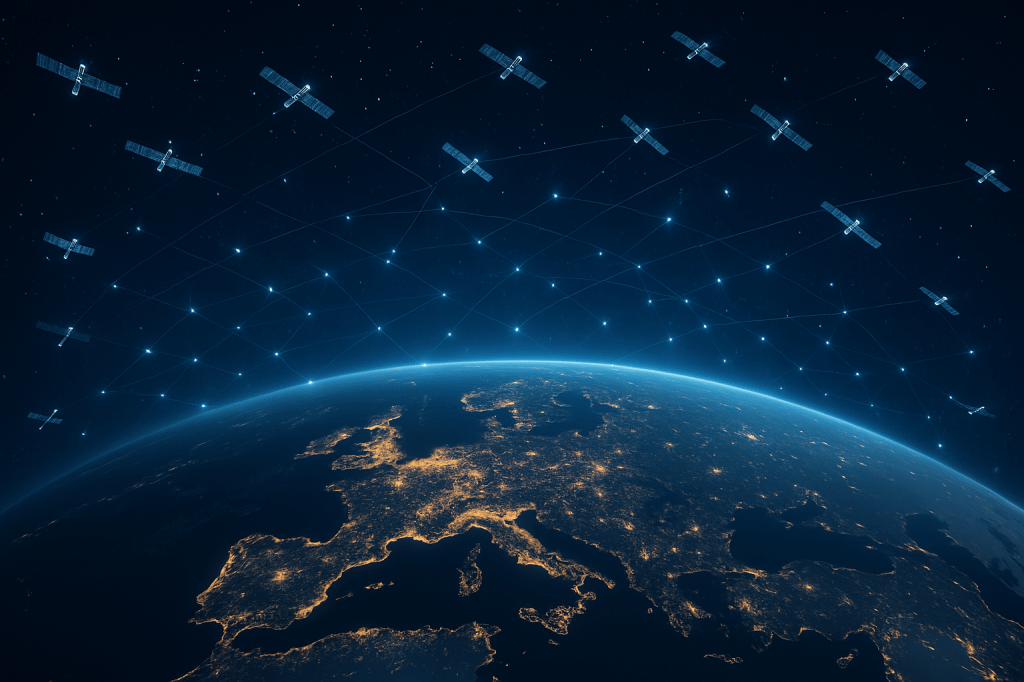
Presently, Europe has some satellite capacity but not nearly enough to be able to substitute for Starlink. The Starlink constellation now consists of 7000 satellite units, to be increased to 12000. The closest thing that Europe has at the moment is Eutelsat/One Web, a French-British venture currently operating close to … 700 satellites. Smaller entities involved in the satellite business in Europe are SES (Luxembourg), Hisdesat (Spain) and Inmarsat (UK). The EU is busy working on IRIS2, an independent satellite infrastructure sponsored by European authorities and private investors. IRIS2 would the most evident alternative to Starlink for Ukraine but the system is expected to be operational … after 2030. Major efforts are put in place to bring this date substantially forward but the base fact is that there is no real alternative to Starlink for the first years to come.
To conclude nevertheless on an optimistic note, let us not forget that the situation on the front line in Ukraine is less gloomy for the Ukrainians than the presidents Donald Trump and Vladimir Putin want us to believe. Sure, Russian troops advance in some areas, but they do so at the expense of huge losses and the Ukrainians are still capable of making counter-inroads too. The Russian army is apparently incapable of taking larger cities. For the retake of the Kursk area Putin needed the support of tens of thousands of North Korean soldiers. And recent Western military intelligence shows that, despite Putin’s claims to the contrary, some parts of the Kursk territory are still in Ukrainian hands.

