
The United States and China are on an unstoppable innovation and productivity growth roller coaster. Aren’t they? Europe’s not doing well on the competitiveness front, but neither the US nor China face a cloudless future.
Europe has a huge competitiveness problem and will have to fight a real uphill battle to close the innovation gap with the United States and China. In an earlier blog I argued that the plans of the European Commission to cure the competitiveness problem will be insufficient . We should however not succumb to the Nirvana Fallacy. The grass is not always and forever greener with the neighbors, in this case the United States and China. Both superpowers must deal with manifest problems of their own that we tend to underestimate. Appreciation of these difficulties for the US and China does not in any way reduce the sense of urgency as far as solving Europe’s own problems are concerned. Complacency is the last thing Europe can afford.
“Complacency is the last thing Europe can afford”
More for less
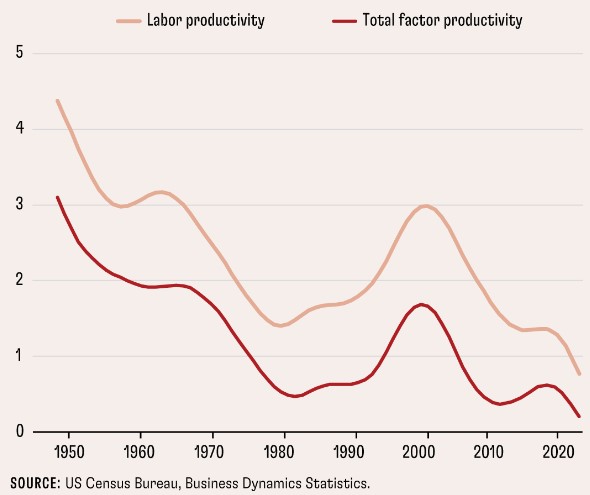
First the United States. A quick look at the data reveals a reality that is somewhat at odds with the now generally accepted success story of the American economy. Let us first look at productivity (graph 1). Both labor productivity and total factor productivity, a measure of the overall productivity in the economy, have followed a highly similar pattern. TFP growth hovered around 3% in 1950 and then started a steady drop finishing at 0.5% by 1980. After a tick up to around 1.5% at the turn of the century a new decline set in. TFP growth is down to even less than 0.5% in recent times (which is, by the way, still better than what we achieve productivity-wise in Europe).
Contrast the productivity growth development with the evolution of the spending on Research & Development in the United States (graph 2). Total R&D spending increased continuously from 2.2% of GDP in 1980 to close to 3.5% of GDP recently. Private R&D spending increased even more spectacularly. Spending rose from 1% of GDP to 2.5% of GDP over the same period. Whereas in 1980 private R&D spending stood for 50% of overall R&D spending, more recently this share of private R&D spending shot up to almost 75% of total R&D spending.
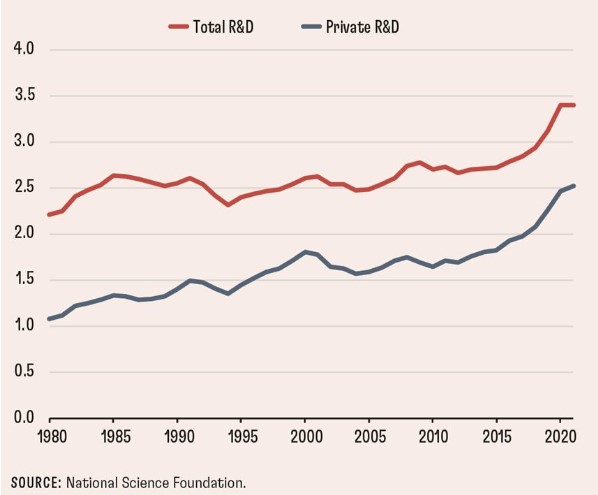
The conclusion is obvious: more spending on R&D has gone hand in hand in the US with a downward trend in productivity growth. This is exactly the opposite of what one would expect to see. What happened? Recent research, with the University of Chicago’s Ufuk Akcigit as a pivotal player, sheds interesting light on what has been labelled as the “innovation paradox” within the American economy. The basic finding of this research is that larger companies have come to dominate private R&D spending more and more. Their R&D spending has however increasingly been channeled towards strategic moves to defend their existing businesses rather than seeking genuine, disruptive innovation.
“The conclusion is obvious: more spending on R&D has gone hand in hand in the US with a downward Smaller companies and start-ups trend in productivity growth.”
Smaller companies and start-ups tend to be much more involved in new, disruptive innovation than larger companies. The growth of these true innovators has often been hampered by large incumbents firms luring away key employees. Ufuk Akcigit defined this as “innovation-stifling hiring”. After 2000 there was a notable increase in the wage premium offered by established companies as compared with salaries paid by younger businesses. Research reveals that employees prised from the smaller innovators tend to lose their innovative drive once they arrive in the larger units. Potential competitors are neutralized in this way and overall innovative effort correspondingly suffers.
Corporate high flyers
It is hard to miss omnipresence of today’s corporate high flyers in the Trump presidency. The presence of the likes of Mark Zuckerberg (Meta), Jeff Bezos (Amazon), Sundar Pichai (Google) and of course Elon Musk during Donald Trump’s inauguration ceremony was there for everybody to see. These billionaires have spent a lot of money to open the doors for them into the Trump administration. They are also much closer than smaller companies to the huge amounts of money that the authorities are allocating to R&D efforts through different government programs. Will their impact on the White House environment be such that they can engage the political machinery of Washington to help safeguard the dominant positions their respective companies occupy today (and this to the detriment of truly innovative efforts)? If they succeed in achieving this goal the negative impact on innovation, productivity and economic growth accordingly to the mechanisms described above will kick in slowly but surely. Productivity figures indicate that this dominant company capture of innovative efforts is already clearly embedded.

A lot will depend on the judiciary system. Will this third power be able to stand its ground against the attacks of the combined forces of the Trump administration and the oligarchic corporate elite? During the Biden administration the antitrust authorities were on high alert as far as the actions of today’s behemoths of corporate America were concerned. Not least given the crucial role these companies play in the intelligence and military infrastructure of the United States it is plausible that the judicial authorities will not make life too difficult for the 21st century robber barons. If so, the consequences for the American economy and its growth potential will be considerable.
The Soviet way?
How about China? When Mikhael Gorbachev came to power in the Soviet Union in 1985 he launched his double track approach of “glasnost” and “perestroika”. Glasnost stood for more openness and transparency throughout society and perestroika intended to restructure the economy along more market-oriented principles. Present-day leadership in China has no doubts whatsoever: it was glasnost, and especially glasnost running ahead of perestroika, that led to the collapse of the Soviet Union, not even three decades after then-Soviet boss Nikita Khrushchev told the capitalist world that “we will bury you”.
Never, ever, so the Chinese leadership under present strongman Xi Jinping is firmly convinced, will China repeat the colossal Gorbachev mistake. Perestroika is okay, but glasnost needs to be limited at all costs. Xi continuously repeats that “government, military, civilian, academic, east, west, south, north, and centre, the party leads everything”. No concessions to freedom and democracy. Under Xi’s leadership China is building a truly frightening digital surveillance state that shows no respect whatsoever for personal freedom.
“Never, ever, so the Chinese leadership under present strongman Xi Jinping is firmly convinced, will China repeat the colossal Gorbachev mistake”
Since Deng Xiaoping started perestroika-like economic reforms at the end of the 1970s the Chinese economy has grown impressively. According to some metrics (for example GDP at purchasing power parity) the Chinese economy is now already larger than the American one. Along the way China moved from world leader in old industries like textiles to leader in steel and shipbuilding and nowadays also leader in new industries, for example solar and wind power, batteries and electric vehicles.
But is the economic dream already over for China? Growth rates of around 10% annually have been replaced by 5%. At least according to China’s official data. Most private analysts consider even that number to be a politically fabricated illusion. Non-official estimates of annual economic growth in China are today more in the 2 to 3% region, if not even lower. The explanation for this spectacular downward trend of economic growth is two-fold.
First, something like 80% of the Chinese economy is facing structural headwinds. Real estate and infrastructure, for example, suffer from excess supply, weak demand and severe financial problems. These financial problems extend to the massive indebtedness of local and provincial governments and of several huge corporate players. Export-oriented traditional industries are suffering, on the one hand, from the competition of other cheap labor economies like Vietnam and Indonesia and, on the other hand, from Western, foremost American, protectionist interventions.
Second, the dynamic modern sectors of the Chinese economy, now accounting for 15 to 20% of the total economy, are hitting the frontier technology wall. This dynamic sector of the Chinese economy includes branches such as clean energy, electric vehicles, robotics, artificial intelligence, biotechnology and pharmaceuticals. Growth in such sectors on the frontier of technological advancement greatly depends on the openness for disruptive innovation. Such openness requires flexible and inclusive political institutions and legal protection of innovators’ efforts. These are characteristics on which the Chinese political system is rather short. As a matter of fact, truly disruptive innovation tends to be looked upon quite suspiciously by the communist political elite.
The example of DeepSeek is instructive in two ways. First, what DeepSeek successfully did was to start from Western technological advances and then scale up quickly and at significantly lower costs. DeepSeek did not come up with really disruptive new technology. Second, DeepSeek’s AI model propagates Chinese government narratives on all the sensitive issues (Taiwan, Tibet, chairman Xi, …). Even DeepSeek is walking the party line. No glasnost.
The basic question for China is whether they can succeed in stimulating disruptive innovation at, or close to, the technological frontiers. At present one is inclined to argue that the rigid political system dominated by the communist party will allow insufficient leeway for this type of innovation. The United States succeeded greatly in stimulating this frontier research and innovation but might be, as argued above, on the way to lose much of its dynamic due to the oligopolistic dominance of large corporate behemoths.
Wanted: European courage
All this means there’s still hope for Europe to fight back and regain lost competitiveness. But such a fight will demand effort and courage, especially from the political world. Can Europe reorganize and reshuffle structurally in order to regain a significant position in the disruptive innovation at the technological frontiers?
More on publications Ufuk AKCIGIT
- AKCIGIT, Ufuk & ATES, Sina, 2021, “Ten Facts on Declining Business Dynamism and Lessons from Endogenous Growth Theory”, American Economic Journal: Macroeconomics 13(1)
- AKCIGIT, Ufuk & GOLDSCHLAG, Nathan, 2022, “Where Have All the “Creative Talents” Gone? Employment dynamics of US Inventors”, NBER working paper, no. 31085
- AKCIGIT, Ufuk & GOLDSCHLAG, Nathan, 2024, “Understanding the Innovation Puzzle. Firm Size, Inventors and Industrial Policy”, University of Chicago working paper
- AKCIGIT, Ufuk & KERR, William, 2018, “Growth through Exogenous Innovations”, Journal of Political Economy, 126(4)

