The European Commission wants to close the “innovation gap” that has undermined our productivity growth and economic and social progress. The Commission is long on good intentions but short on those reflections and policy actions that are really needed to bring about the much-needed push to European innovation.
Competitiveness Compass
Under the guidance of Frans Timmermans, the Green Deal on climate policy took centerstage during the first European Commission presided by Ursula von der Leyen (2019-2024). For von der Leyen’s new term (2024-2029), it is increasingly likely that competitiveness and innovation will claim the pole position in this Commission’s priority list. As such, the Commission presented its Competitiveness Compass in January, “providing a strategic and clear framework to steer the Commission’s work”.
“Over the last two decades…”, so von der Leyen argued in her presentation, “…Europe has not kept pace with other major economies due to a persistent gap in productivity growth”. To close that gap “longstanding barriers and structural weaknesses” must be removed. Von der Leyen pointed to three core areas for action: closing the innovation gap; a joint roadmap for decarbonization and competitiveness (with outspoken attention for energy prices that are today killing large parts of Europe’s industrial base); and reducing excessive dependencies and increasing security.
Innovation gap
I focus here on “the innovation gap” because I wholeheartedly agree with Mario Draghi on his recent diagnosis. In his already much-discussed Draghi Report he stated that “first – and most importantly – Europe must profoundly refocus its collective efforts in closing the innovation gap with the US and China”. For advanced economies, including Europe, current trends notwithstanding, it is innovation and even more so disruptive innovation that is the main driver of productivity growth and economic progress.
Alphabet soup
In its Compass the European Commission is unrestrained, readily unveiling new concepts and institutions: AI Continent, AI Gigafactories, Scale-up Strategy, Clean Industrial Act, Affordable Energy Action Plan, Industrial Decarbonisation Accelerator Act, Clean Trade and Investment Partnerships, Omnibus Proposals, Horizontal Single Market Strategy, Union of Skills, Competitiveness Coordination Tool, Competitiveness Fund … Is buried beneath this dazzling alphabet soup of interventions and actions a “profound refocus”, as Mario Draghi so appropriately worded it, of Europe’s much needed efforts? I fear it isn’t, or at least not to a truly impactful degree.
Double whammy
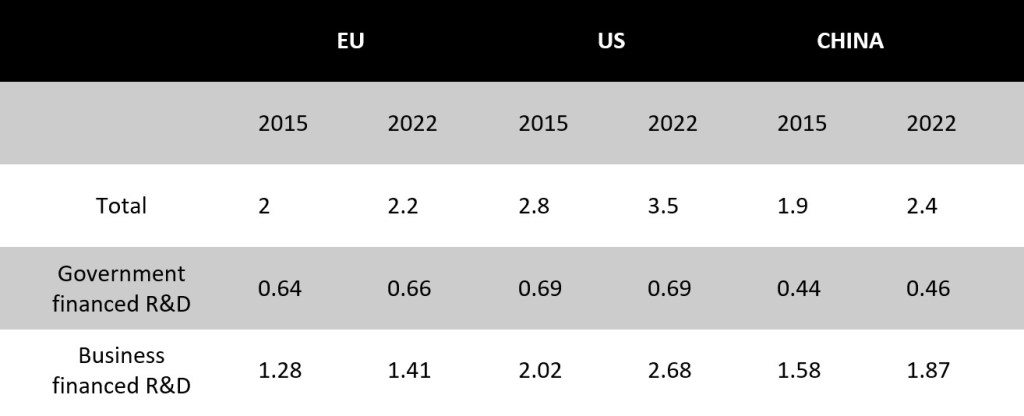
Focusing on the gap with the United States, a first striking observation is that it is not true that overall public spending on R&D is lower in Europe. As the accompanying table shows, public spending on R&D as a % of GDP is in fact almost identical in Europe as it is in the US. However quantity of spending is one thing, quality of that spending is another. European public R&D spending is fragmented, with the EU and 27 member states all playing some role. Fragmentation makes for lots of foregone opportunities and inefficient overlaps. In the US R&D funding is more readily concentrated at the federal level and much more focused.
“It is not true that overall public spending on R&D is lower in Europe.”
Europe does not have something even remotely resembling the American Advanced Research Project Agencies (ARPAs), where decision making and project management are delegated to top scientists with minimal direct political interference. Among the ARPA-driven success stories can be counted the internet, GPS and the Covid mRNA vaccines. A creative and meaningful modernization of the existing European Research Council and/or European Innovation Council could have been a significant move in the ARPA-direction. Unfortunately this type of measure is not really contemplated in the Commission’s plans.
“Will each euro spent really be judged on the altar of competitiveness?
I don’t think so.”
In other areas a fundamental critical evaluation and rethinking of existing policies and practices is imperative. This exercise should occur not only at the level of member states, but certainly also at the EU level. The Commission limits itself to promises on eliminating overlaps and increasing efficiency of EU spending. Stéphane Séjourné, Commission Executive Vice President and responsible for industrial policy, argued that increasing competitiveness should be “in every euro that we will spend”. Of the EU’s 190 billion euro annual budget roughly one third goes to cohesion spending and one third to agricultural support. Influential lobbies and powerful political forces anxiously guard the status quo in these spending categories. Will each euro spent really be judged on the altar of competitiveness? I don’t think so.
Dwarfed?
The second major problem for Europe is its lack of business spending on R&D compared to the US. Business spending on R&D in the US is almost double that in Europe (2.7% of GDP versus 1.4%). Moreover, private R&D spending in Europe is concentrated not in high-tech but in mid-tech branches like the automative sector. Almost 90% of US business R&D spending is in high-tech branches like ICT, AI and biotech, in Europe this is below 50%. Taking patents in AI as an example, Europe is dwarfed by the US and China. But, as I will argue in a second blog on competitiveness, all this does not mean that the advantages the USA and China enjoy today are permanent.
Europe still has significant pockets of scientific excellence to call upon. European scientists still account for 20% of the world’s top 1% most-cited scientific publications. This rate is only slightly less than the share held by Americans (22%) and Chinese (25%). What has long bedeviled Europe has been turning this scientific excellence into innovative, market-relevant successes. For that crucial step to become much more a reality dramatic changes in the broader European environment of innovation and investment need to take place. The Commission intends to act on some of these needed changes but neglects or misjudges important ones.
Creative destruction
The Commission wants too much to be in direct control, a lingering managerial style.
A basic characteristic of present-day innovation, most of all innovation related to AI, is underappreciated in the Commission’s approach. Innovative AI developments are being triggered by start-ups, rather than the incumbent dominant firms. The recent example of the niche Chinese AI start-up DeepSeek shocking the entire AI community with their R1-model very much illustrates this point. What is new and revolutionary today is less so a few months later. Innovation on steroids, so to speak. The political world is wholly incapable of closely supervising this process in a constructive way. This can only be done by ARPA-like structures guided by top scientists in the context of a vibrant entrepreneurial scene. The Commission’s proposals touch upon elements of this start-up-cum-scientific-lead approach but do not give it the central role it needs to have. The Commission wants too much to be in direct control, a lingering managerial style.
A second element of fundamental change is the need for a different attitude and mindset towards creation and destruction. For new developments to have room to spread their wings some existing structures need to change or even disappear. Capital needs to be liberated, labor too. If capital and labor remain stuck in archaic structures, innovation, productivity and economic growth suffer. The late Joseph Schumpeter (1883-1950), one of the most brilliant economists ever, defined creative destruction as the most defining characteristic of an innovative and growing economy. Much more than the United States, Europe is in the business of preservation and hence blocking all too much destruction and creation. Here the responsibilities of the individual member states with respect to the future of creative destruction and constructive creation are immense.
“Existing structures need to change or even disappear.”
Several policy areas, at the national as well as the European level, require serious overhaul in order to redraw the creation-preservation-destruction triangle. Bankruptcy law must allow for much quicker finalization of bankruptcy procedures. Also, bankruptcy should be de-shamed in Europe. A much more flexible labor market is also urgently needed. Unions and left-leaning political parties will staunchly resist such changes. In the face of such resistance we must be unequivocal: either we accept more flexible labor market, together with several other urgently needed new policies and attitudes, or we have to shelve the desire to close the innovation gap and regain our international competitiveness. Once more we cannot have our cake and eat it too.
Zombie firms
Destruction, and hence creation, has also been much hindered by the very accommodative monetary policies of the last two decades. Extremely low interest rates and massively abundant liquidity allowed for the survival of companies where their real competitiveness had been seriously reduced, the so-called zombie firms. Zombie firms, as economic research ably demonstrates, artificially survive, block creative destruction and hence weigh heavily on innovation and productivity growth. Central banks’ responsibility for headwinds to innovation and productivity is considerable.
Thirdly, the Commission must invest significant political capital in strengthening the internal market and on progressing with the capital markets union. Both objectives are explicitly stated by the Commission, but not for the first time. That same intention was also very much emphasized in manifold past policy declarations without impressive results. A well-functioning internal market that is substantially reinforced, mostly related to services, is absolutely needed for innovative initiatives to be able to scale up. In turn, this establishes a European foothold in the fierce international competition fight. A more unified capital market is necessary to generate the private funding needed to allow the scaling-up of truly innovative ventures.
“Innovators need to be protected through IP rights and the rule of law.”
Last, but not least, the Commission hardly mentions the issue that should central in any serious policy discussion on innovation. Innovators need to be protected through IP rights and the rule of law. This protection must be limited, otherwise monopoly profits and market protection kick in and start strangling further innovative efforts. This trade-off between on the one hand protecting standing innovators and on the other hand not hindering potential innovators is at the heart of innovation or industrial policy. Competition policy plays a crucial role in this trade-off, that is at the heart of successful management of a market economy.
Don’t throw money around
Finally, the idea of a Competitiveness Fund needs to be addressed in a serious way. In some European quarters there is a clearly distinguishable tendency to make this Fund into the central element of the drive for a more competitive Europe. It seems to be a hard lesson to learn that throwing money around is not the solution, on the contrary even. The availability of (lots of) money almost inevitably pushes much needed reforms to the background, leading in a most perverse way to a demand for even more money (to throw around).
“It seems to be a hard lesson to learn that throwing money around is not the solution.”
Some discuss allowing the Commission to raise 500 billion euros from the capital markets to fill the coffers of this Competitiveness Fund. Reference is then almost always made to the Recovery and Resilience Fund (RRF). The RRF raised 700+ billion euros to help member states fight the consequences of the Covid 19 pandemic and to increase the resilience of the European economy. Maybe this is not the best example to refer to. Reporting by the European Court of Auditors (ECA) and a rapidly mounting number of potential fraud cases investigated by the European Public Prosecutor’s Office (EPPO) should be a real wake-up call for the political establishment. To put it euphemistically: there is much to be improved upon as far as RRF spending is concerned. A thorough and impartial review of RRF spending should be on the table before new initiatives are even contemplated. Several member states are voicing outspoken opposition towards RRF-like constructions, for good reason.
“To put it euphemistically: there is much to be improved upon as far as RRF spending is concerned. “
Avoid a shark attack
If, nevertheless, a Competitiveness Fund eventually sees the light of day, everything must be done to avoid a shark attack on its funding by large incumbent companies. They have the connections and the lobby power to make such a coup into a success (that is, a success for them). The past provides ample evidence of the way in which European funds have been raided by “European Champions”. Opening the money spigots even more in this way would be a disaster for Europe’s competitiveness and innovative capacity. As already argued above, it is not from large dominant companies that the future manna for our progress will come. Instead,the scientifically guided start-up entrepreneurial scene properly guided by scientific and not political considerations can drive competitiveness in Europe, as in the US.
DOWNLOAD
 Johan Van Overtveldt